Azzeddine Tajjiou, a researcher, translator and academic from Morocco, has been named the inaugural recipient of the Third World Quarterly (TWQ) Kassahun Checole Award in African Studies, an initiative dedicated to recognising and championing the work of emerging African scholars and writers.
Tajjiou will receive the award today at the African Studies Association of the UK (ASAUK) 2026 Conference in Durham, marking an important moment for a prize established to amplify African scholarship and literary work, bring it to wider audiences, and strengthen the place of African voices, ideas and intellectual traditions within global academic and literary conversations.
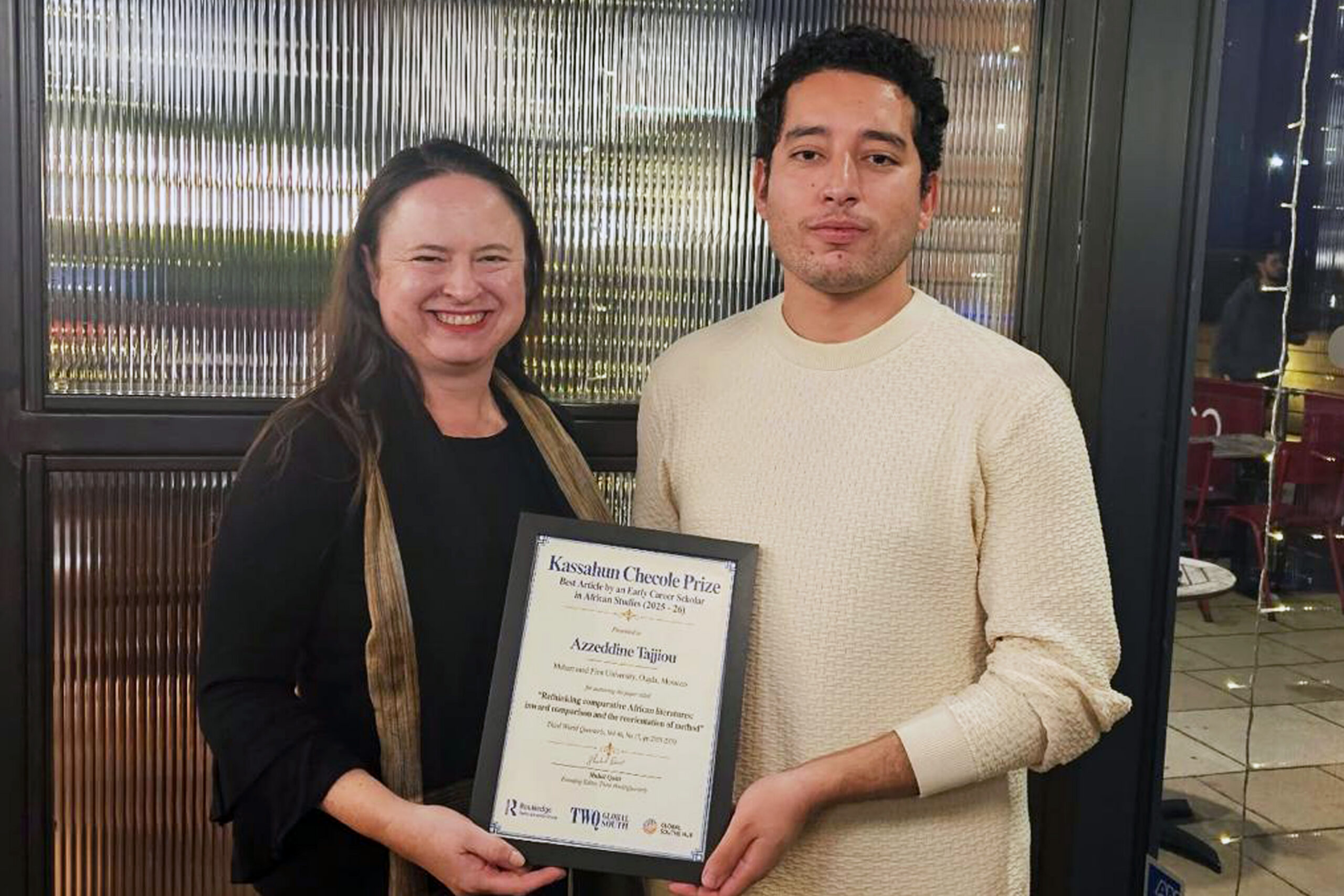
| Elizabeth le Roux awarding the Kassahun Checole Prize to Azzeddine Tajjiou |
Tajjiou, whose research focuses on African and postcolonial literatures, is a university adjunct lecturer and is currently completing his PhD at Mohammed First University in Morocco. His article ‘Rethinking comparative African literatures: inward comparison and the reorientation of method‘ (Third World Quarterly, Volume 46, 2025) asks us to reconsider how African literature is studied and compared. Rather than simply bringing more African writing into existing academic frameworks, he argues in this article that African literary traditions should help shape the ways in which literature is understood and analysed.
The three judges, Chair of the Prize Committee, Professor Beth Le Roux (Publishing Studies, University of Pretoria, South Africa), TWQ Academic Editor, Samson Opondo (Associate Professor of Political Science and Africana Studies and Chair of Political Science, Vassar College, USA), and TWQ Editorial Board Member, Abebe Zegeye (Centre of Research and Development in Learning, Addis Ababa, Ethiopia) commended the article which positions African literary production as the central node for
understanding comparative world literatures, rather than applying other models to Africa.
“We felt the article stood out for its sustained critique of the framing of African knowledge production in terms of centre and periphery, and for its insistence on the centrality of African epistemologies. Azzeddine’s piece displayed innovation, rigour and critical thinking that the award seeks to encourage.
It is a tribute to Kassahun’s vision of foregrounding African authors, narratives, and voices, making their knowledge production visible and engaging with global discourse on their own terms. Kassahun worked as a traiblazer in publishing the work of emerging and established African scholars to prioritise the African perspective, considering not just who is is being published, but also from what perspectives, to “know Africa through African eyes”.
Professor Beth Le Roux
The runners up for the award are also examples of valuable research being conducted
across the African continent: ‘From Conflict to Cooperation: Pathways Toward the
Resolution of Resource Conflicts in Agropastoral Communities in Ghana’ by Tobias Tseer (a
Lecturer at Simon Diedong Dombo University of Business and Integrated Development
Studies in Ghana); Promise Frank Ejiofor (doctoral candidate in Development Studies at
the University of Cambridge); and ‘Aid Sanctions and Constitutional Order: The US and
France’s Responses to Military Coups in sub-Saharan Africa by Inesta Brunel Lendzoumbou
(PhD candidate at Nankai University, China).
We caught up with Azzeddine to find out what inspired the article.
1. What does winning the prize mean to you?
It means a great deal to me, both personally and intellectually. I began working on the larger project behind this article more than three years ago, at a point when there was very little support around me for the direction I wanted to take. There was some scepticism about whether a project concerned with rethinking comparison from within African literary traditions could make a substantial methodological intervention. I remained convinced that the question was worth pursuing.
“What makes this recognition especially meaningful is that the prize bears the name of Kassahun Checole, whose career has been devoted to creating spaces in which African scholars, writers, and intellectual traditions can speak with greater authority on their own terms. In that sense, the recognition feels particularly close to the intellectual commitments of the article itself.”
Azzeddine Tajjiou
For an early-career scholar, there are long periods when you work without knowing whether an argument will travel beyond your own desk or whether other people will see the necessity you see in it.
This prize tells me that the conversation I have been trying to enter matters to others as well. More than anything, it gives me encouragement to continue developing this work and to push it much further.
2. Was there a particular moment, book, writer or experience that first made you think, “We need a different way of studying African literature”?
Ngũgĩ wa Thiong’o has probably been the most important presence behind that question for me. I kept returning to the intellectual struggle associated with Ngũgĩ, Henry Owuor-Anyumba, and Taban Lo Liyong at the University of Nairobi, and particularly to their deceptively simple question: why should African literature not occupy the centre from which other literatures are encountered and understood? That question stayed with me because its implications extend well beyond what appears on a syllabus. It is ultimately a question about where knowledge begins. Ngũgĩ’s later work, especially Decolonising the Mind (1986) and Moving the Centre (1993), reinforced for me the idea that decolonisation also requires attention to the categories, relationships, and habits through which knowledge is produced.
When I moved more seriously into comparative literary studies, I began to see a related problem. African texts were increasingly present within comparative and world-literary scholarship, yet the methods through which they became comparable often continued to originate elsewhere. That discrepancy interested me. I began wondering what comparison would look like if African literatures themselves supplied its points of departure, its historical relationships, its aesthetic correspondences, and eventually some of its theoretical vocabulary.
“Inward comparison” grew from that question. I see it as part of a much longer intellectual conversation initiated by African writers and scholars who insisted that Africa should participate in producing the terms through which its literatures are studied.
3. What inspired this research? Why do you feel this research is particularly important now?
The research emerged very directly from my doctoral work. My PhD examines corruption and hope across Anglophone African novels published between 1954 and 2004. I was reading writers from different countries, generations, political histories, and literary traditions, while trying to understand why certain structures, anxieties, historical memories, and imaginative responses seemed to speak so powerfully to one another.
That created a methodological problem for me. How do we compare African texts across national boundaries without flattening their differences, and without requiring them first to pass through theoretical categories developed elsewhere before their relationships become legible? I became increasingly interested in what the texts themselves were already telling us about the grounds on which comparison could take place. Shared and different colonial histories mattered, but so did aesthetic forms, oral traditions, political experiences, structures of memory, linguistic relationships, and forms of intertextuality circulating within Africa itself. That is where the idea of “inward comparison” began to take shape.
“How do we compare African texts across national boundaries without flattening their differences, and without requiring them first to pass through theoretical categories developed elsewhere before their relationships become legible?”
Azzeddine Tajjiou
4. Why do you feel this research is particularly important now?
I think the question has particular urgency now because African literature has achieved extraordinary international visibility. It is taught, translated, published, awarded, and circulated globally on a scale that earlier generations fought hard to make possible. Yet greater visibility does not automatically settle the methodological question. We also have to ask who determines the terms under which these works become produceable, readable, comparable, and theoretically significant.
For me, the next stage of the conversation concerns the task of allowing African literatures to participate more fully in producing literary knowledge rather than functioning primarily as material to which already established theories are applied.
5. Now that the article has won a prize, what do you hope readers will take away from it? Is there anything you hope it might change about the way African literature is studied or discussed?
I hope readers come away from the article with a central question. What might we discover if African literatures generate the grounds of comparison themselves? “Inward comparison” invites us to explore that possibility. It asks critics to attend more closely to the relationships among African texts, including their conversations across regions and languages, their shared and divergent histories, their aesthetic genealogies, their oral and written forms, and the concepts that emerge from those encounters. I would be delighted if the article encouraged African scholars and students to approach African literature with greater confidence as a source of theoretical production.
I also hope the argument is understood as an opening for further inquiry, not as a fixed method. African literature is too linguistically, historically, and aesthetically expansive to be contained by a single approach. “Inward comparison” is one contribution to a much larger collective project. If the article changes anything, I hope it changes the direction of our first question. Instead of asking which established theory can explain an African text, we might begin with the texts, histories, languages, and intellectual traditions themselves. We might then ask what concepts become possible from within those materials.
That shift may seem modest, but it could have far-reaching consequences for comparative African literary studies as a field.
ABOUT AZZEDDINE TAJJIOU
Azzeddine Tajjiou is a Moroccan researcher of African and postcolonial literatures, a translator, and a university adjunct lecturer completing a PhD at Mohammed First University, Morocco. His research spans comparative African literatures, cultural studies, decolonial ecocriticism, environmental humanities, and literary translation. He is a CNRST Doctorant-Moniteur Fellow (2023-26), an African Fellow of the Harry Frank Guggenheim Foundation (2025-26), and an Associate Fellow of York University’s Harriet Tubman Institute (2025-ongoing). He has held funded research stays at THALIM, CNRS/Sorbonne Nouvelle, and at Harvard’s Institute for World Literature as a fully funded Balzan Colloquium member. His research has been published in leading international journals and presented at various international conferences.