Purniya Awan, a Gender, Sexuality, and Women’s Studies graduate from York University, Canada and Global Souths Hub’s Contributing Editor and Social Media Manager writes about her understanding of Indigenous People’s histories as a Canadian. In recognition of the International Day of the World’s Indigenous Peoples (August 9), she shares a personal journey of learning, unlearning, and standing in solidarity with Indigenous communities—tracing a path from classroom silence to critical awareness.
Across every continent, Indigenous Peoples continue to uphold ancient traditions, protect fragile ecosystems, and transmit knowledge that has been refined over thousands of years. Yet, they remain disproportionately affected by poverty, displacement, loss of language, and systemic discrimination.
International Day of the World’s Indigenous Peoples urges the global community to not only to recognise these contributions, but to take meaningful action to address historical injustices, uphold Indigenous rights, and promote true equity and inclusion. This year focuses on, Indigenous Peoples and AI: Defending Rights, Shaping Futures. AI can support Indigenous communities but often reinforces bias and misuses their data due to lack of input. Respecting Indigenous rights, inclusion, and data sovereignty is essential for AI to truly empower them. Massive data centres can also affect Indigenous lands, resources, and ecosystems, adding to the existing barriers to technology access in rural areas. This further limits Indigenous participation in AI development and decision-making.
Around 200 groups of Indigenous Peoples currently live in voluntary isolation and initial contact. They reside in remote forests, rich in natural resources, in Bolivia, Brazil, Colombia, Ecuador, India, Indonesia, Papua New Guinea, Peru and Venezuela. These communities are essential in the preservation of our world’s green spaces. Their territories, which make up just 22 percent of the planet’s surface, are home to 80 percent of Earth’s remaining biodiversity. Respecting their land rights helps both ecosystems and cultures thrive.
The survival of these communities isn’t just vital to safeguarding our planet, it is also essential in preserving the world’s cultural and linguistic diversity. At least 43 percent of the 7,000 languages spoken in the world today are endangered, and of the world’s 370 million indigenous peoples, these communities are estimated to speak more than 4,000 different languages. Preserving these languages is essential for knowledge, as with the loss of language comes a loss of history and ideas.
UNESCO and Indigenous Rights: Protecting Cultural and Linguistic Diversity
UNESCO (the United Nations Educational, Scientific and Cultural Organisation) plays a vital role in advancing the rights of Indigenous people, particularly in the domains of education, culture, and science. A major initiative is the International Decade of Indigenous Languages (2022–2032), which aims to reverse the rapid extinction of native languages.
Through heritage preservation, inclusive education policies, and research partnerships, UNESCO also works to safeguard Indigenous knowledge systems. It emphasises the need for curricula that integrate Indigenous histories and philosophies, promoting culturally responsive learning rather than assimilationist models of education.
Read free-to-view articles from Central Asian Survey, Third World Quarterly, Kōtuitui: New Zealand Journal of Social Sciences Online and Canadian Foreign Policy Journal on the topic of indigenous languages:
- Framing language policy in post-Soviet Azerbaijan: political symbolism and interethnic harmony, Kyle L. Marquardt, Central Asian Survey, 24 May 2011
- A community under siege: exclusionary education policies and indigenous Santals* in the Bangladeshi context, Mrinal Debnath, Third World Quarterly, 18 Sep 2019
- Imagining possible worlds with young children, families, and teachers: sustaining indigenous languages and family pedagogies, Janet S. Gaffney, Jenny Ritchie, Mere Skerrett (Ngāi Tahu, Ngāti Māhuta, Ngāti Unu, Ngāti Pikiao, Ngāti Pūkeko), Graham Hingangaroa Smith (Ngāti Apa, Ngāti Kahungunu, Te Aitanga a Hauiti, Kāti Māmoe), Diane Mara (Tahitian/English), Angus Hikairo Macfarlane (Ngāti Rangiwewehi, Ngāti Whakaue) & Christine Sleeter, Kōtuitui: New Zealand Journal of Social Sciences Online, 12 Sep 2021
- Balancing acts and breakthroughs: Canada’s journey with linguistic diversity, indigenous rights, and the UN Declaration to inspire public service innovation, Carolyn Laude, Canadian Foreign Policy Journal, 27 Feb 2025
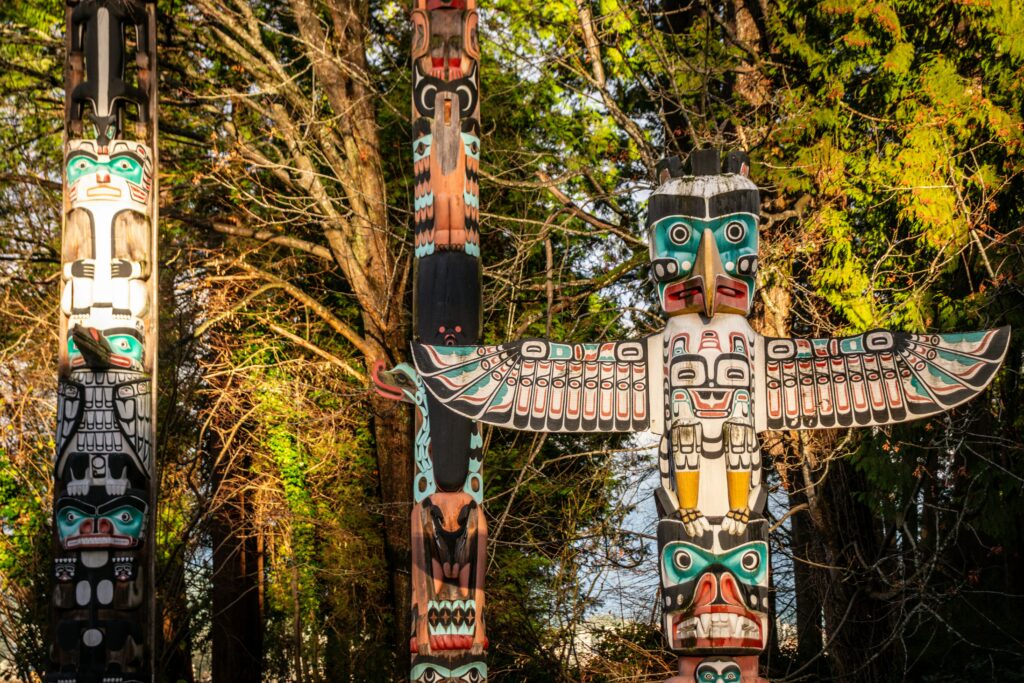
Vancouver Stanley Park “Indian Totem Poles” Aboriginal Indigenous tribe art and culture in winter light. Source: Unsplash
My Experience at York University – Canada’s Past is Still Present
Indigenous communities exist across the globe, and the experiences of those in the Global North are often overlooked when we speak about the impacts of colonisation. To truly decolonise our education systems, all Indigenous narratives must be included.
While studying in Canada, I came to understand that the more I learned about First Nations history, the more I was forced to confront the painful truths about the country I was being educated in – a nation built on land that has always belonged to Indigenous Nations, many of whom have been dispossessed of their ancestral territories till date. Among the most harrowing aspects of this colonial legacy is the residential school system, a state-sanctioned project of cultural genocide.
Beginning in the 1800s and continuing until 1996, the Canadian government, in collaboration with Christian churches, operated over 130 residential schools across the country. These institutions forcibly removed over 150,000 First Nations, Métis, and Inuit children from their families. The goal was explicit: to assimilate Indigenous children into Euro-Canadian society by erasing their languages, beliefs, and identities. Children were often forbidden to speak their native tongues or practice their customs. Many endured systemic physical, emotional, and sexual abuse.
According to data reported by The Guardian in 2021, the mortality rate in some residential schools reached 30 percent, with children dying from disease, neglect, or mistreatment. Over 3,200 deaths have been formally documented, though Indigenous leaders believe the number is significantly higher. The graves of children, many unmarked, have been found at over 1,300 potential burial sites. This includes the infamous Kamloops Indian Residential School, where the remains of 215 children were discovered using ground-penetrating radar.
The Truth and Reconciliation Commission of Canada (TRC), which concluded in 2015, labelled the residential school system as an act of cultural genocide. It issued 94 Calls to Action, urging all sectors, including government, education, healthcare, and civil society to address the legacy of colonialism. While some progress has been made, many of these calls remain unfulfilled.
For survivors, these findings were not news, but painful validation of stories long ignored.
Sacred, Not Silent: Ending Violence Against Indigenous Women
One of the most urgent crises in Canada is the epidemic of gender-based violence against Indigenous women, many of whom have gone missing or been murdered along British Columbia’s notorious Highway of Tears. This stretch of road has become a symbol of systemic neglect. First Nations leaders and advocates argue that authorities have shown a disturbing lack of urgency in investigating these crimes or bringing those responsible to justice.The documentary Highway of Tears sheds powerful light on these tragedies and the voices demanding accountability.
From Acknowledgment to Action
At university, learning about Indigenous history is no longer treated as optional or peripheral; it is essential. Through land acknowledgments, guest lectures from Indigenous scholars, and courses on Indigenous law, literature, and resistance, I am beginning to understand not only the truth of what happened but the responsibility that comes with that knowledge.
But understanding is only the first step. World Indigenous Peoples Day challenges us to move from passive acknowledgment to active solidarity. This means amplifying Indigenous voices, supporting language revitalisation, pushing institutions to respond to the TRC’s recommendations, and confronting the colonial systems that remain deeply embedded in our society.
To participate in the day’s commemorative activities, you can sign-up for this online UN event where speakers will discuss how Indigenous Peoples rights can be ensured in the age of AI, and the associated challenges and opportunities Indigenous Peoples face, taking place on August 8, 2025 at 9:00 – 10:30 a.m. EDT, New York time.
A Path Forward
This day is about future-building. Indigenous peoples are leaders in the fight against climate change, in sustainable development, and in a powerful cultural renaissance – reviving languages, reclaiming traditional knowledge systems, revitalising ceremonies, and reaffirming identity in the face of centuries of colonial erasure.
As learners, educators, and citizens, we must all ask: Are we truly learning from all histories? What are we doing to ensure that Indigenous knowledge is included in our education systems?
To commemorate and celebrate the voices, histories, and contributions of Indigenous Peoples around the globe, we’ve curated a selection of temporarily free-to-view articles from Third World Quarterly (TWQ) and Central Asian Studies (CAS) that we hope will inform, inspire, and amplify continued reflection and dialogue:
- Language and the quest for liberation in Africa: The legacy of Frantz Fanon, Alamin Mazrui, Third World Quarterly, 15 Nov 2007
- From ethnocide to ethnodevelopment? Ethnic minorities and indigenous peoples in Southeast Asia, Gerard Clarke, Third World Quarterly, 25 Aug 2010
- Indigenous voices and the making of the post-2015 development agenda: the recurring tyranny of participation, Third World Quarterly, Charis Enns, Brock Bersaglio & Thembela Kepe, 15 May 2014
- Tradition and modernity: an obsolete dichotomy? Binary thinking, indigenous peoples and normalisation, Celine Germond-Duret, Third World Quarterly, 17 Feb 2016
- Indigenous peoples’ responses to land exclusions: emotions, affective links and power relations, Sochanny Hak, Yvonne Underhill-Sem & Chanrith Ngin, Third World Quarterly, 13 Aug 2021
- Postcolonial Bangladesh and neocolonial assimilative literacy practices: the case of private schools and English language programmes, Firoze Alam, Third World Quarterly, 29 Aug 2023