How can literature help us better understand the political, cultural, and historical realities of the Global South?
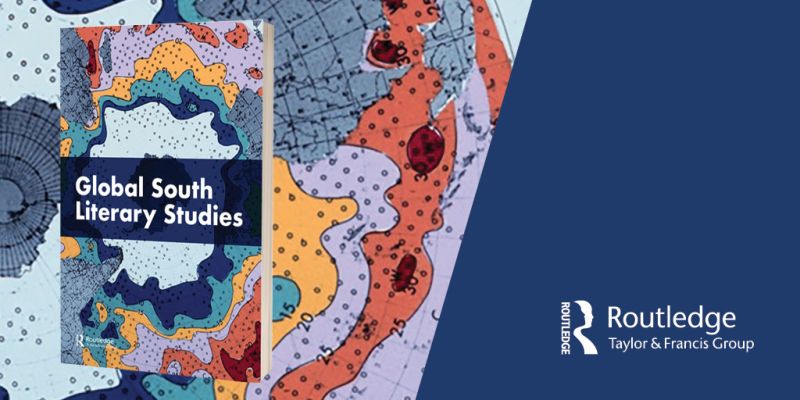
The Global South Literary Studies (GSLS) journal, published by Taylor and Francis, launched in 2025. This exciting new space allows scholars, writers, and thinkers to examine the literary and cultural expressions emerging from the Global South with the aim of advancing understanding of the complex and diverse realities of the area.
Rather than being prescriptive to a geographical, superficial or limiting definition of ‘Global South’ the journal approaches the Global South as dynamic and evolving. As editor Goutam Karmakar (Assistant Professor of English, University of Hyderabad, India) explains, the journal encourages its authors to consider contrasts as well as connections, reflecting the polyphonic reality of the Global Souths and opening new ways of thinking.
What topics does the journal accept?
The Global South Literary Studies journal welcomes a wide range of submissions that explore literary and cultural expressions across the Global South.
The journal scope covers:
- Fiction and non-fiction
- Drama & poetry
- Graphic novels and comics
- Oral histories and other non- traditional forms of expression
For more information regarding the aims and scope of the journal, submission guidelines and
other logistics, please visit the journal at https://www.tandfonline.com/journals/rgsl20
“In the coming years, the journal would like to see more submissions of research articles from new and emerging literary narratives and genres from the Global South countries.”
Goutam Karmakar
Special Issues: Now Accepting Submissions
Political Violence and Literary Responses in South and Southeast Asia since the 1940s
Special Issue Editor(s)
Angshuman Kar, The University of Burdwan, India
politicalviolenceissuegsls@gmail.com
Subhadeep Ray, Bidhan Chandra College, Kazi Nazrul University, India
politicalviolenceissuegsls@gmail.com
This special issue attempts a comprehensive critical scrutiny of literary reflections on concrete episodes and intersectional historical and geographical networks of political violence in South and Southeast Asia with attention to the nuances of this field.
Submission Instructions
A 500-word abstract (excluding bibliography) and a 100-word bionote should be sent as a single MS Word file to special issue editors Angshuman Kar and Subhadeep Ray (politicalviolenceissuegsls@gmail.com) no later than May 15, 2026. If you have any questions, do not hesitate to contact the special issue editors. The guest editors will communicate their decision on the abstract submission by May 31, 2026. The deadline for submitting full manuscripts is September 30, 2026. Articles should be no more than 8,000 words.
Read the full instructions for authors
Submit an article to Global South Literary Studies
Frames, Terrains, and Worldings: Comics and Storytelling across the Global South
Special Issue Editor(s)
Ajith Cherian, GITAM School of Humanities and Social Sciences, Hyderabad, India
comicsgsls@gmail.com
Ana Ferreira, School of Education, University of the Witwatersrand, Johannesburg, South Africa
Sathyaraj Venkatesan, Department of Humanities and Social Sciences, National Institute of Technology, Tiruchirappalli, India
Comics from the Global South function as hybrid epistemic objects that are simultaneously literary, visual, political, and pedagogical, mediating between oral and written traditions, artisanal and digital practices, and local storytelling modes and global cultural circuits. Often emerging from visual and textual traditions that predate Western formulations of comics, the Global South comics developed sophisticated grammars of sequence, rhythm, and narrativity. Shaped by colonial rule, postcolonial modernity, religious pluralism, and global capitalism, Global South comics instantiate new ways of thinking about postcolonial visuality, vernacular modernities and decolonial aesthetics. These genealogies structure and inform the aesthetics and politics of comics, ranging from documentary and mythological comics to feminist, queer, and justice-oriented graphic narratives.
Submission Instructions
A 500-word abstract (excluding bibliography) and a 100-word biographic statement should be sent as a single MS Word file to special issue editors Ajith Cherian, Ana Ferreira and Sathyaraj Venkatesan (comicsgsls@gmail.com) no later than July 15, 2026. If you have any questions, do not hesitate to contact the special issue editors. The guest editors will communicate their decision on the abstract submission by August 15, 2026. The deadline for submitting full manuscripts is December 31, 2026. Articles should be no more than 8,000 words.
Read the full instructions for authors
Submit an article to Global South Literary Studies
More Upcoming Special Issues
Global South Literature in and out of South Asia
Special Issue Editor(s)
Nalini Iyer, Seattle University, USA
niyer@seattleu.edu
Pallavi Rastogi, Louisiana State University, USA
prastogi@lsu.edu
Scholars working across Africa–Asia relations, Sino–South Asian histories, Jewish diasporas in India, Afghan refugee studies, South–South travel writing, and associated South-South disciplines are invited to submit abstracts on literary texts, including memoirs, travelogues, novels, poetry, and drama.
Dalit Studies in India: Interrogating Epistemological Injuries and Silences
Special Issue Editor(s)
Arunima Ray, Lady Shri Ram College for Women, University of Delhi, India
arunimaray@lsr.du.ac.in
Milind E. Awad, Jawaharlal Nehru University, India
milindawad1@gmail.com
This special issue seeks to foreground the notion of epistemological injuries and silences in its multiple manifestations, subtle and overt, across the language and literature of Dalit narratives, further exploring the ongoing processes of counter-canon and mainstreaming Dalit voices within the production of knowledge and culture. The special issue also intends to examine the rise of young Dalit artists and scholars who are making them visible in the mainstream spaces today. The focus will also be on what challenges confront those who seek to bring Dalit discourse to the centre.
Interested in proposing a Special Issue? Please write to the editor of the journal, Goutam Karmakar, on goutamkrmkr@gmail.com.