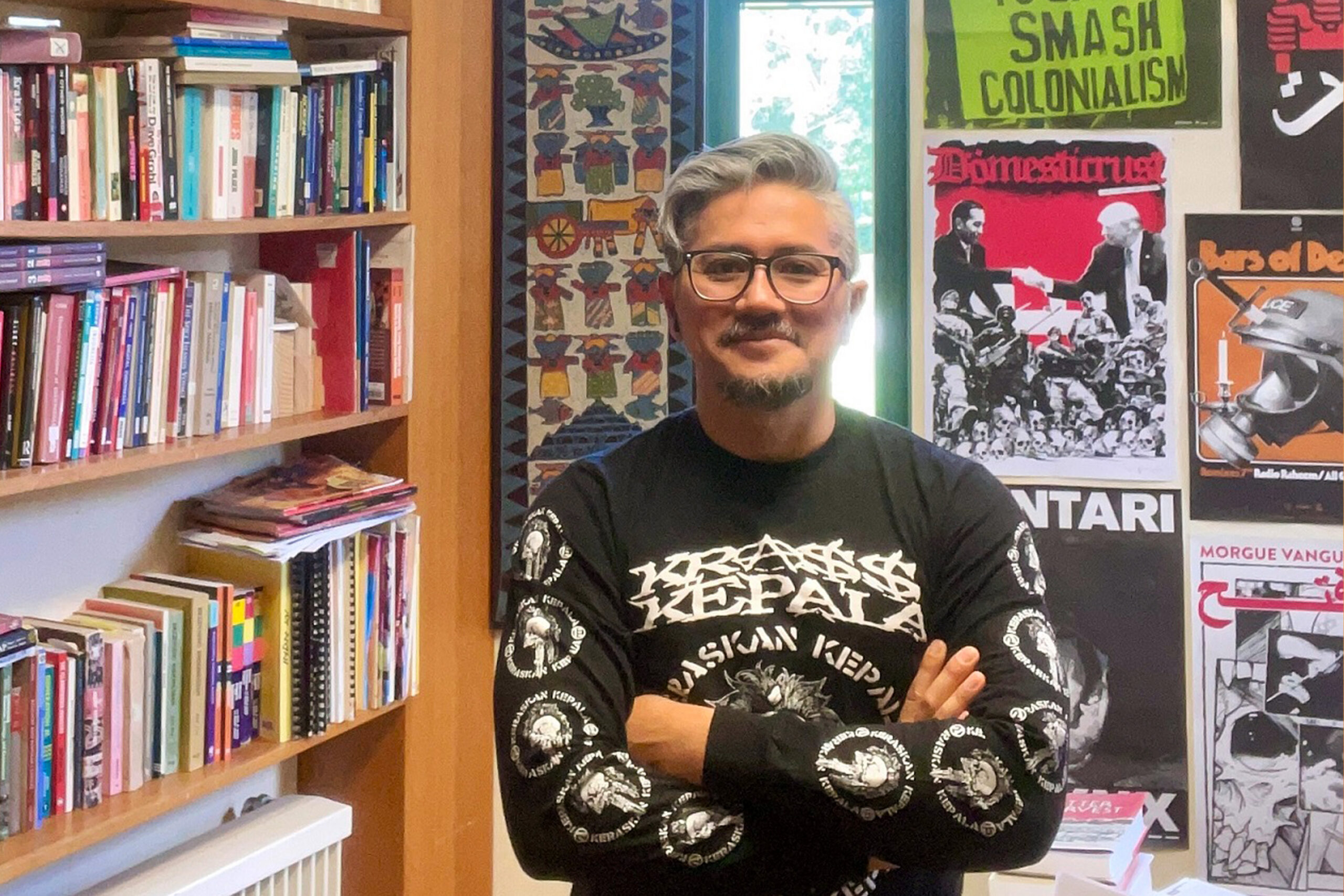
In this Q&A, Hikmawan ‘Indra’ Saefullah, lecturer in Politics, Extremism, Philosophy, Studies in Religion, and Peace Studies at the University of New England, talks to Mira Mookerjee about punk’s role to challenge political oppression, his experiences with Pelajar Islam Indonesia (PII) and the new wave of punk bands coming out of Indonesia today.
1. Prior to becoming a lecturer, you were part of Indonesia’s underground music scene and you were involved in political activism in the 90s – how did these experiences influence your academic interests?
I never thought I would become a musician or a student activist – let alone an academic. I was simply doing what I enjoyed and what I felt I had to do. As a kid growing up in Indonesia’s Bandung (a cosmopolitan city rich with youth culture) in the 1990s, I was fortunate enough to immerse myself in the local underground subculture. The experience provided me with a space to explore and negotiate my identity, creativity, values, and principles – things that guided me through everyday life when living under the New Order’s authoritarian regime. It also provided a space for dissent, where I could question power and authority, and resist what oppressed my generation. Through the community, I also learned the importance of equality and solidarity and how to make friends beyond rigid, hierarchical social stratifications.
I began participating in student activism in the early 1990s, almost by accident. My older brother sent me to a “Pesantren Kilat” – a short-term religious learning programme typically held in schools or outdoors during school holidays. But this programme turned out to be something else entirely: it was a basic leadership training (Latihan Dasar Kepemimpinan) organised by the Indonesian Islamic Students (PII), a student organisation that had been banned by the New Order government due to its ideological and political opposition to the state since the early 1980s. I did not regret joining. They opened my eyes to social issues and taught me discipline, leadership, confidence and the courage to speak up in the face of injustice. These were essential for anyone or any movement that aims to create meaningful social change. This activism led to my involvement in the broader student movement that later toppled Suharto and his authoritarian regime in the late 1990s.
My experience in student activism allowed me to engage with diverse political narratives, particularly Islamism, Nationalism, and Leftism, since some of the participants were affiliated with these ideologies and organisations. This brought me to an idea of writing an honours thesis about the study of Islamic fundamentalism, a topic which had gained renewed prominence in the wake of the September 11 (9/11) attacks. My thesis sought to dismantle the conventional barriers between the “Right” and the “Left” by examining the impact of the 1979 Iranian Revolution on the rise of the Islamic Left (Al-Yasar al-Islamiy) of Hassan Hanafi in Egypt. It received an excellent response from the panel when I defended it in my exit seminar, and my supervisor recruited me directly to join his teaching team after my graduation. For over seventeen years, beginning in 2005, I worked as a lecturer at the Department of International Relations, Faculty of Social and Political Sciences, Padjadjaran University, Indonesia.
“My experience in student activism allowed me to engage with diverse political narratives, particularly Islamism, Nationalism, and Leftism, since some of the participants were affiliated with these ideologies and organisations.”
Hikmawan ‘Indra’ Saefullah

In 2009, while searching for a topic for my Master’s thesis, I was inspired by the work of International Relations (IR) scholars Kevin C. Dunn and Matt Davies. Their work drew attention to a fundamental problem within traditional IR scholarship: its failure to engage with the issues that matter most to ordinary people in their everyday lives. The positivistic and elite-centred analysis that dominated the discipline excluded everyday people from its frameworks, contributing to a scholarly blindness that, unfortunately, created the world’s catastrophic events, such as the 9/11 terror attacks, climate crises, wars, famine, and poverty. These issues are particularly prominent in the countries that scholars now collectively refer to as the “Global South.” IR theorists and analyses produced narratives that ultimately benefited the Global North while further impoverishing the Global South.
The Global South and its concerns had become, in Matt Davies’ terms, “alienated” by traditional IR scholarship. Punk’s Do-It-Yourself (DIY) ethos, Davies argued, could function as a means to disalienate the discipline. In a similar vein, Kevin Dunn contended that punk could “offer new ways of thinking about international relations and communication from the lived experiences of people’s daily lives.” I was struck by their arguments and how they are relevant to what I was doing as an IR academic. As a result, I chose a topic for my MA in International Relations thesis that mattered deeply to me and to the people around me – the Indonesian punk and underground scene – under the title “Punk Rock as Counter-Hegemony.”
My experience as a musician and participant in the Indonesian underground music scene and Islamic activism resonated directly with the emerging “Islamic Underground” phenomenon that unfolded between the mid-2000s and 2015. During this period, some underground musicians – individuals who had previously been part of, (or sympathised with), the radical Left movement – shifted toward Islamic conservatism and right-wing Islamism, and used their subcultural experience to create a new movement called the “Islamic Underground Movement.” It was in this context that I pursued my PhD by writing a PhD thesis on the Transformations of Youth Resistance: Underground Music Scene and Islamic Politics in Post-Authoritarian Indonesia at Murdoch University. Not only was the topic timely, but it’s also very relevant to my past lived experience.
Having decided to move permanently to Australia to be closer to my wife and son, who are Australian citizens, I joined the University of New England in 2023 as a Lecturer in Indonesian Studies. In 2026, I transitioned into my current role as Lecturer in Politics and Extremism.
2. Can you tell me more about your experience as a musician and your student activism during the Reformasi era?
The popularity of alternative music and punk rock, partly introduced through corporate media such as MTV and HAI magazine in the mid-1990s, led me to a new hobby: playing music. Great bands like Green Day, Rancid, The Offspring, and NOFX, among others, inspired me to form a punk trio called Sick Ring, which later evolved into a ska punk band, Haben Nagen.
The band was not political. For us, it was for fun. However, as I delved deeper into the local underground music scene in Bandung throughout the late 1990s and early 2000s, I began to see that the social and cultural practices within the scene formed a kind of rebellion – one in which young people began to subscribe to narratives of anti-authoritarianism, anti-militarism, and anti-capitalism, introduced partly through the music they listened to and literature scene. While some local punks developed their subcultural practices to engage in political activism by joining social movement organisations associated with the radical Left in the late 1990s, my own activism had already begun well before that and was on a different ideological spectrum.

“Punk music itself was never really dead; it has been transforming ever since, both musically and politically.”
Hikmawan ‘Indra’ Saefullah
I joined an Islamic social movement called Pelajar Islam Indonesia, or the Indonesian Islamic Students (PII), in 1994, around the same time I came to know about punk and underground subcultures. The movement itself was one of the oldest youth/student organisations in Indonesia, established in 1947 to unite Indonesian students who, at the time, were fragmented along ideological lines: the secular (sekuler) and the religious (santri).
One year later, PII was involved in the armed struggle to defend Indonesia’s newly declared independence from the Dutch military aggression that aimed to recolonise the country. It created a paramilitary wing, Brigade PII, and some of them took part in supporting General Soedirman, later recognised as Indonesia’s national hero, in his guerrilla warfare against the Dutch military aggression.
By the 1990s, however, PII was no longer engaged in armed struggle. Instead, it was fully focused on intellectual development and organisational leadership. At PII, I was taught for the first time not to be afraid of speaking up and standing up for what is right. By this time, PII’s struggle was student empowerment and against state authoritarianism. This opposition started in the early 1980s, when PII publicly opposed the state’s “Mass Organisations Bill” (RUU Ormas), which obliged all civil society organisations to adopt the state ideology of Pancasila. We believed this bill was used by Suharto to suppress criticism against his political regime and to sustain the status quo.
This opposition led to a bloody incident known as the Tanjung Priok Massacre in 1984, where at least dozens of its activists doing street protests were killed by the Indonesian Army. This massacre served as another form of ‘shock therapy’ that successfully silenced other activists enabling the Bill to be passed the following year. Since I joined PII in the 1990s, I was very active in recruiting young people like me, mostly high school students, despite the consistent state surveillance of our activities. The recruitment was aimed at helping young people become confident in themselves, develop their own leadership and critical thinking skills, build solidarity and learn to work with others – teaching them to “hidup berorganisasi,” or to embrace collective organising as a way of life and create social change.
During the tumultuous period of 1997 and 1998, I organised the mobilisation of high school students to join thousands of university students rallying around the historic Gedung Sate in Bandung, in support of the Reformasi agenda. Together, we demanded Suharto to step down and call for him and his cronies to be brought to justice. Although Suharto was successfully toppled due to the mounting mass popular pressures, I feel the struggle was incomplete, since the subsequent Indonesian government administrations failed to bring Suharto and his cronies to justice.
3. Your PhD explores youth resistance, music, and Islamic politics – what were key insights?
My PhD thesis explores how youth resistance is transformative in nature, continually adapting to changing social, political, and economic conditions. Its key arguments are multifaceted.
First, it challenges the common assumption that youth subcultures, particularly punk, metal, and other underground subcultures, are inherently progressive, left-wing, and resistant to conservative politics.
For a long time, punk has been associated with radical Left movements and ideology, specifically anarchism, due to its anti-authoritarian and anti-capitalist stance. My research demonstrates that the uneasy transition from New Order authoritarianism to post-authoritarian Indonesia brought the underground movement to a crossroads—one that was not only diverse but also deeply fragmented. Some of its participants, those who were disillusioned with the nihilistic aspect of the underground music scene and the leftist movement, embraced religious conservatism and right-wing Islamism. Those who shifted to religious conservatism and right-wing Islamism often brought their subcultural experience to their new movement that oriented toward their religion, creating a new movement, such as the “Islamic Underground Movement” and “Hijrah Movement”, among others.
Second, rather than simplistically arguing that right-wing Islamists infiltrated the underground music scene, my thesis suggests that religion, in this case, Islam, provided the disillusioned participants with new meaning, discipline, a renewed sense of belonging, solidarity and community, and moral certainty.
These are precisely the kinds of anchors that young people seek in an age of uncertainty, especially when a large segment of the population, especially pro-democracy activists and supporters, has been disempowered and demoralised by a post-Suharto political and economic environment that has betrayed the very promises of reform it was built upon.
4. Your current research sits at the intersection of youth, politics, and extremism. Can you tell me more about this?
“I argue that underground subcultural practices, from forming bands, organising DIY music shows, to creating DIY fanzines, and producing DIY merchandise, clothing, record labels, and distros, provided a space for these youths to reconnect with the cultural resistance and radical political tradition that challenged the New Order’s status quo.”
Hikmawan ‘Indra’ Saefullah
I am currently working on a few things in a very small window. The first is an article on how marginalised youths in Indonesia drew on underground subcultural practices as a means of political engagement — reviving, in new forms, a tradition of youth activism long suppressed by the New Order regime since the late 1960s. I argue that underground subcultural practices, from forming bands, organising DIY music shows, to creating DIY fanzines, and producing DIY merchandise, clothing, record labels, and distros, provided a space for these youths to reconnect with the cultural resistance and radical political tradition that challenged the New Order’s status quo. This radical political tradition was reintroduced through foreign punk and metal song lyrics and symbolism, offering them an alternative identity, lifestyle, and worldview to the one imposed by the state.
When scholars discuss extremism, they often focus on non-state actors, typically social and political groups on the fringes of society that possess a dangerous ideology and actively recruit young people to challenge the state or the ruling order. Although it is not the main focus of the article, through its historical context, I try to remind readers that extremism is not always represented by non-state actors; it can also be perpetrated by the state itself.
Indonesia in the mid-1960s was a perfect example of this process. The military used state resources and infrastructure to seize power and destroy its legitimate political opponents, particularly communists, radical leftists, and Sukarnoist–National Leftist/Marhaenist groups. Anti-communist propaganda was distributed and amplified, while right-wing extremists and vigilante groups were trained, funded, and supported by the military to persecute and murder hundreds of thousands to at least a million communists and their alleged sympathisers from 1965 throughout the late 1960s. As Max Lane said in his book, Unfinished Nation: Indonesia Before and After Suharto (2008), the mass murder itself was designated as a ‘shock therapy’ to eradicate the Left, to intimidate any future movements that might challenge the state. This shock therapy was added by the military regime’s enforcement of policies in the 1970s that were designed to strip citizens, specifically student activists, of their rights to engage in political activism and mobilise protests.

Second, together with a friend and fellow metal musician from Indonesia, I have begun working on a new research project exploring aging and precarity among punks and metalheads in Indonesia. Specifically, we examine what happens to these punks and metalheads as they transition into adulthood and take on new commitments such as family and work. How do they negotiate their ongoing commitment to the music scene while also maintaining their new responsibilities to family and the workplace, particularly within a precarious political and economic environment?
“Throughout the 1990s, punk was known for its DIY culture, anti-capitalist ethos, and anti-establishment attitude.”
Hikmawan ‘Indra’ Saefullah
5. Do you see a revival in the punk music scene? What do you think this has been caused by?
I am not sure if “revival” is the right term, since the punk music scene has evolved considerably over time. Punk was considered “dead” – Punk Is Dead – in the late 1970s, when British punk bands, particularly the Sex Pistols and the Clash, were absorbed by the mainstream music industry. But punk music itself was never really dead; it has been transforming ever since, both musically and politically. The British punk band Crass led this transformation, pioneering new genres of punk that were more political, anti-commercial, and autonomous — anarcho-punk, sometimes referred to as “DIY punk.” A similar phenomenon also occurred within the Indonesian punk scene in the late 1990s.
Throughout the 1990s, punk was known for its DIY culture, anti-capitalist ethos, and anti-establishment attitude. However, as mainstream media co-opted punk and underground subcultures, signing bands to major record labels, sponsoring music events and rock bands, punks were no longer considered “political,” as it was seen as vulnerable to being co-opted by mass media and corporate commercialism. This was evident in the commercialisation and commodification of the punk and underground music scene, where not only did corporations infiltrate the scene for their own marketing agenda, but many of those who grew up in the punk scene also chose to work with corporations to meet their material needs (You would call it selling out!).
Yet many failed to see that while these processes of commercialisation and commodification were playing out, there were punks who maintained their authenticity—DIY punks and anarcho-punks who continued producing their own music, organising their own concerts, creating fanzines, and engaging in political activism, without being sponsored by or working with corporations.
6. Do you think music still has the power to create political or social change?
Recently, I came to embrace what my friend Herry Sutresna – better known as “Ucok Homicide” and Morgue Vanguard, a punk and hip-hop veteran and activist – told me for many years: “Music can’t change the world.” For a long time, I thought he was being pessimistic about the potential of music to create social and political change. But I came to understand what he truly meant (I guess it’s better late than never) – when another friend, Kevin C. Dunn, a punk rocker, professor of political science, and music and film director, said something remarkably similar while delivering a keynote at the Music and Political Mobilisation Symposium that my friends and I organised at the University of New England. He said: “Music doesn’t matter.”

In other words, both Ucok and Kevin were making the same point: music itself does not have agency, but people do. It is people who have the power to shape political and social change; music alone cannot do anything. People use music as an instrument for making change. They are the ones who insert meaning into music; without them, music simply has no meaning. Yet as long as people continue to imbue their music with critical meaning and a transformative worldview, music can continue to inspire social and political change, but again, the real power remains within people.
7. What is the current music scene and youth culture like in Indonesia right now?
Arguably, the Indonesian music scene today is more vibrant than ever. A new generation of bands and musicians has emerged with brilliant work, producing songs that have become hit singles very easily. Music organisers and producers have become increasingly more professional, while musicians themselves have become more creative and mature in their musicality. Much of this growth has been supported by the advancement of media technologies, which have made it significantly easier to produce and distribute music independently through the internet. Digital streaming platforms such as Bandcamp, Spotify, YouTube Music, and Apple Music, as well as social media, especially TikTok and Instagram, enabling musicians to bypass many of the traditional gatekeepers of the music industry.
6. With more than 50% of Indonesia’s population of 270 million consisting of young people between ages 18 and 39 years old, how do you think the new generation are going to shape Indonesia’s future?
For me, this is a difficult question to answer. On the one hand, Indonesia’s large youth population can be viewed in a positive light – what Indonesian government institutions have termed a “demographic bonus,” or what the United Nations refers to as a “demographic dividend.” On the other hand, this same population can become a national burden if tens of millions of young people have no access to high-quality, well-paying jobs. If their welfare and employment are guaranteed once they complete their mandatory schooling and university degrees, they will undoubtedly contribute to building a better future for Indonesia.
At present, however, many of these young people are living in precarious economic conditions where access to high-quality, well-paying jobs is severely limited and the labour market remains deeply insecure. Indonesia’s youth unemployment rate is arguably among the worst in Asia — worse than both Vietnam and Thailand. As a result, many graduates, including university graduates, end up working in the gig economy as digital platform drivers, where they have no stable income and are at high risk of exploitation.
7. Who are some of the most exciting punk bands coming out of Indonesia today?
There are many, but to mention some of them: Sukatani, Mesin Tempur, The Jansen, Billfold. I like Sukatani and Mesin Tempur the most. The duo post-punk band, Sukatani, created songs with lyrics that are relevant to the realities that what Indonesian punks deal in everyday life, like autonomy (“Tanam Kemandirian”), ageing or getting old (“Semakin Tua Semakin Punk”), consumerism (“realitas konsumerisme”), solidarity (“Jangan Bicara Solidaritas”), and corruption (“Bayar, Bayar, Bayar”). The last song brought the band into trouble, since it bluntly criticised the Indonesian Police corruption and attracted national attention.
The second band is what I would call “comedy punk.” Mesin Tempur combines highly skilled crust punk, hardcore punk, and metal musicianship with lyrics about absurdly funny everyday topics – all sung in my national and ethnic languages, Indonesian and Sundanese (from West Java). Their songs cover subjects like cooking instant noodles (“Mana Tukang Indomie”), learning how to read (“Mari Membaca”), a tipped-over pedicab (“Becak Tiguling”), and a supposedly scary death metal persona (“Aku Death Metal”). But, you can still enjoy the music on its own merits without needing to understand the lyrics.
8. What are your plans for future projects?
I am currently preparing a book proposal based on my PhD thesis. I have received several invitations from publishers over the years but have not yet had the opportunity to pursue them seriously due to the demands of a new academic position and growing family commitments. Hopefully, I’ll be able to finish it by the end of this year, so the book writing can commence next year. Wish me luck!
Further Reading
- Punk in the Global South: A Reading and Resource List
- Transformations of Youth Resistance: Underground Music Scene and Islamic Politics in Post-Authoritarian Indonesia at Murdoch University by Hikmawan Saefullah (Indra)
- Unfinished Nation: Indonesia Before and After by Max Lane
- Global Punk: Resistance and Rebellion in Everyday Life by Kevin Dunn