How do Palestinian classrooms counter dominant narratives in the media? And how can education become an epistemic infrastructure for narrative sovereignty? In this blogpost, Hussein AlAhmad, an Associate Professor of Strategic Communication at Arab American University in Palestine, asks these questions and reflects on his recently published Third World Quarterly article.
In Palestine, education is rarely neutral. Students enter classrooms carrying more than books: they arrive with phones full of headlines, testimony, omission, and competing claims about the world around them. Media literacy is often presented as a remedy for misinformation, but under conditions of occupation and unequal visibility, the deeper challenge is how some realities are made credible while others are softened, displaced, or ignored.
In this landscape, questions emerge, such as, what counts as a “fact”? Whose voices gain recognition? And which narratives acquire legitimacy? The answers to these questions are often shaped by media infrastructures and geopolitical hierarchies that extend far beyond the classroom, and the answers are rarely neutral.
Gaza and the Limits of Visibility
The recent war on Gaza illustrates this tension. Digital and social media have created unprecedented visibility, allowing citizens to document events in real time and circulate testimony globally.
At the same time, algorithmic moderation, uneven media amplification, and entrenched geopolitical narratives continue to shape how these accounts are received and interpreted, and whether they circulate widely or disappear into digital noise. Visibility alone, therefore, does not guarantee narrative authority.
This dilemma raises a fundamental question for education: what role can classrooms play when the struggle over knowledge itself becomes part of a broader political contest?
From Media Literacy to Narrative Sovereignty
“Narrative sovereignty refers to the capacity of learners to examine how narratives are constructed, circulated, and legitimised.”
Hussein AlAhmad
The research presented in my recent article Reclaiming narrative sovereignty: education as counter-narrative in Occupied Palestine in Third World Quarterly on 2 Feb 2026, which explores the capacity of communities and learners to critically interpret and interrogate dominant representations and to articulate their own accounts of lived reality.
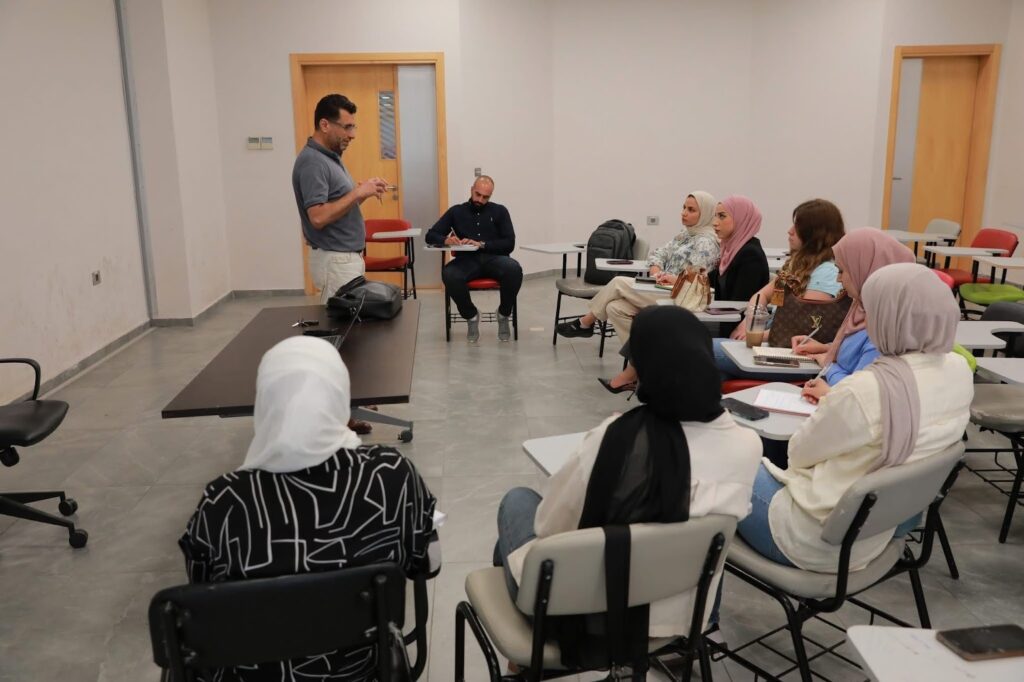
Rather than treating education simply as a site for technical media literacy, the study examines how university students in Palestine engaged with news coverage of the Gaza war through structured classroom discussions and analytical exercises. I explore whether participatory media and critical awareness can help students move through both digital and territorial constraints, and whether the classroom can become a place where dominant narratives are questioned. This proposes understanding educational environments as infrastructures, where students can learn to interrogate the politics of knowledge production itself.
Narrative sovereignty refers to the capacity of learners to examine how narratives are constructed, circulated, and legitimised within unequal information systems, which voices were amplified or marginalised, and how geopolitical narratives shaped public interpretation.
Media Consumption and Critical Engagement
The study involved 140 Palestinian university students from five universities, who took part in 12 workshops designed to examine how different media systems frame the same events. Through these sessions, students critically compared narratives across local, regional, and international coverage.
In one workshop, students placed headlines side by side and asked what disappears when the wording is changed. For example, they compared how the same event could be framed as “clashes” in one outlet, while another explicitly named actors and actions. This contrast revealed how language can obscure responsibility or redistribute it.
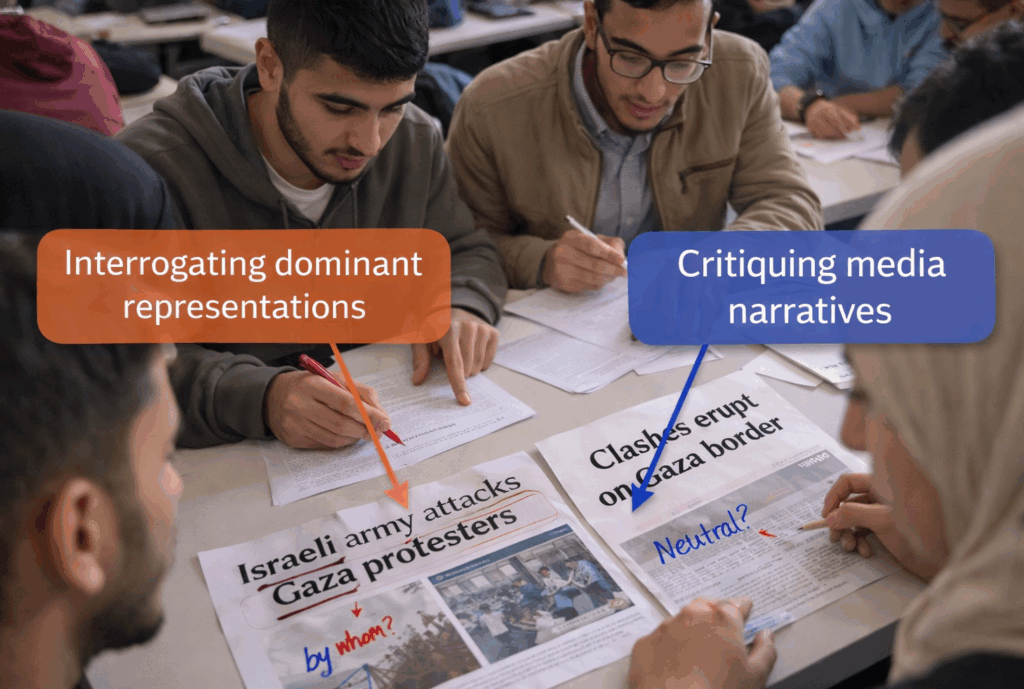
A term such as “clashes” no longer reads as neutral and took on a new meaning once they compared it with language that clearly identified actors and actions. As one student put it, “We used to just scroll; now we stop and ask: who is calling it ‘clashes’? Who gains from that?”
What emerged from these classroom practices was not simply an improvement in verification skills in what’s true and false, but a deeper form of epistemic engagement. Students increasingly began to approach media content as something to be interrogated rather than passively consumed. They compared international and regional sources, traced patterns in how events were framed, and reflected on how global media hierarchies influence the way local experiences are interpreted and understood.
This shift was often expressed in simple, practical terms. One participant reflected, “After spending hours finding the right photo and caption to show the reality of the checkpoint, I can’t just scroll past a headline anymore. I have to stop and ask, ‘Where is the proof? Who is speaking?’ It’s become a habit.”
The Classroom as an Epistemic Infrastructure
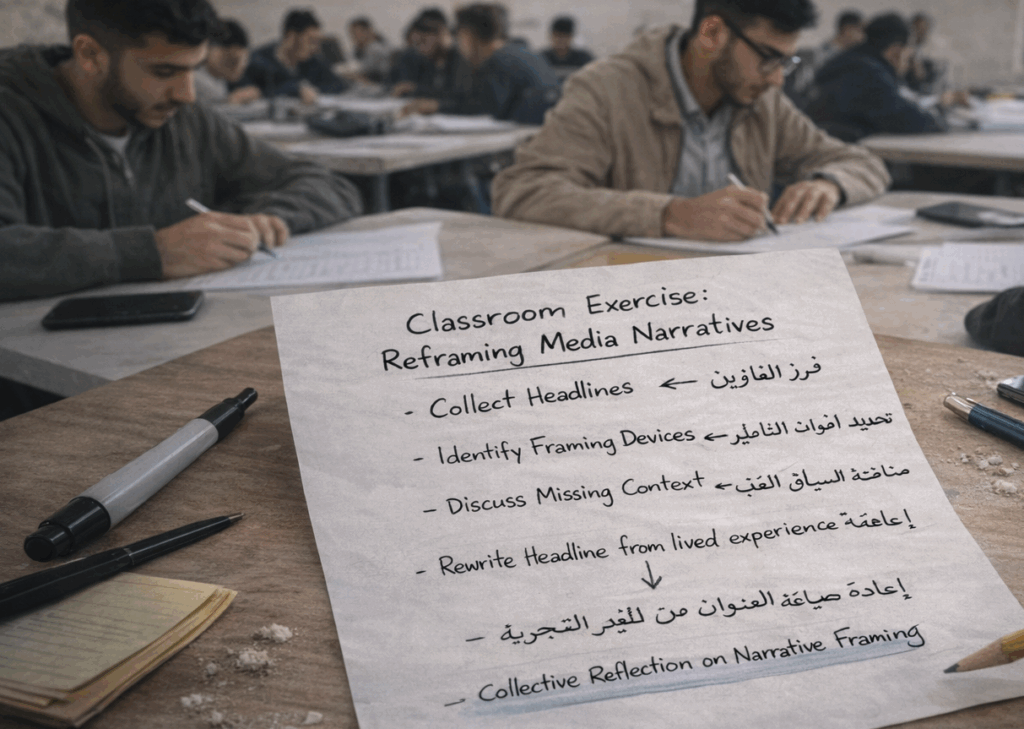
In this sense, the classroom functioned as more than a learning environment. It became an epistemic infrastructure – an institutional space where students could collectively examine and reconstruct the conditions through which knowledge is produced, becomes credible and is made politically consequential or relevant.
Such practices have broader implications for education in the Global South. In many societies facing political instability, conflict, or post-colonial power asymmetries, educational institutions are often discussed primarily in terms of access, resources, or curriculum reform. Yet another question has become urgent: who has the authority to interpret reality and to define which narratives are seen as legitimate?
In this context, education takes on a dual role. It remains a site of knowledge transmission, but it also becomes a space where students learn to navigate contested information environments and reclaim interpretive agency.
The workshops moved beyond critique into practice. Some students rewrote headlines while others created short media pieces that connected public language to lived experience. As one journalism student put it, “We don’t just read headlines anymore. We try to fix the story they wrote about us.” Another participant captured the frustration that still remained: “Our posts may circulate, but they vanish fast.”
Why Critical Distance Matters
Critical distance allows students to develop the ability to question dominant narratives while scrutinising their own assumptions. In a post-truth environment, this capacity is increasingly essential.
Through comparative analysis and reflective discussion, students learned to approach media content as something to investigate and not accept. These practices build habits of inquiry that extend beyond the classroom.
The concept of narrative sovereignty therefore points toward a broader rethinking of the relationship between education, media systems, and political life. In a world where information flows are increasingly mediated by platforms, algorithms, and geopolitical agendas, the capacity to critically interpret narratives becomes a crucial civic skill.
The Four Practices of Narrative Agency
This approach rests on four connected practices:
- First, students learn to notice how language can hide responsibility, especially when unequal realities are flattened into neutral-sounding phrases (lexical decoloniality).
- Secondly, they then compare official narratives with lived experience, treating verification as more than fact-checking but as a way of restoring context (testimonial fact-checking).
- Third, students become more alert and aware of how algorithms shape what gets seen (visibility) and what gets ignored online (algorithmic resistance).
- Finally, they are encouraged to question how platforms and AI systems influence whose voices are amplified, moderated, or erased (institutional decolonisation of AI).
Together, these practices help move media literacy beyond basic defensive skill-building toward narrative agency even within constrained environments.
The Classroom as a Space for Narrative Agency
Although rooted in Palestinian universities, the approach speaks to wider contexts shaped by disinformation, censorship, and enforced silence.
If universities are to remain meaningful institutions, they must do more than serve as repositories of knowledge. They must also create spaces where students can think critically about the conditions under which knowledge itself is produced and contested.
From this perspective, the classroom emerges as a space where narrative agency can be collectively cultivated. Conducting this work was not without challenges. Access constraints, interruptions, and the broader conditions of instability shaped both participation and continuity, making the classroom itself a fragile but necessary space for this kind of engagement. It is where students learn not simply to consume information, but to actively participate in the resistance against erasure in the ongoing struggle over meaning, representation, and political legitimacy.
Further Reading
- AlAhmad, H. (2026) ‘Reclaiming narrative sovereignty: education as counter-narrative in Occupied Palestine’, Third World Quarterly. Available at: https://doi.org/10.1080/01436597.2026.2628272
- AlAhmad, H. and Kukali, E. (2023) ‘The mediatization of education: classroom mediation as an agent of change in Middle Eastern higher education systems’. Springer. Available at: https://doi.org/10.1007/978-3-031-42693-3_11
- Tawil-Souri, H. (2012) ‘Digital occupation: Gaza’s high-tech enclosure’, Journal of Palestine Studies. Available at: https://www.tandfonline.com/doi/citedby/10.1525/jps.2012.XLI.2.27%4010.1080/tfocoll.2023.0.issue-GazaTwoDecades?scroll=top&needAccess=true
- Freire, P. (1970) Pedagogy of the Oppressed. New York: Continuum. Available at: https://books.google.ps/books?id=M4MQAAAAYAAJ
- Chomsky, N. and Herman, E.S. (1988) Manufacturing Consent: The Political Economy of the Mass Media. London: The Bodley Head. Available at: https://files.libcom.org/files/2022-04/manufacturing_consent.pdf
- Strömbäck, J. (2008) ‘Four phases of mediatization’, The International Journal of Press/Politics. Available at: https://doi.org/10.1177/1940161208319097
About Hussein AlAhmad
Hussein AlAhmad is an Associate Professor of Strategic Communication at Arab American University–Palestine. His work explores mediatized conflict , narrative sovereignty, and decolonial pedagogy, with particular attention to how students preserve voice, memory, and epistemic agency under conditions of occupation and digital constraint.