
Climate justice is often framed as a divide between the Global North and Global South. But injustice is also produced through competing visions that shape the transition to a greener future. Speaking at the Development Studies Association Conference, Nigatu Abebe Wolkanto, an early-career researcher at Wolaita Sodo University in Ethiopia, argues that rethinking climate justice requires looking beyond the North–South binary.
When I began my PhD back in 2019, I was interested in a deceptively simple question: how can countries pursue ambitious development goals without sacrificing the wellbeing of the communities most directly affected by them? That question led me to Ethiopia’s Gibe III hydropower project, one of Africa’s largest dams and one of its most contested infrastructure developments. What I did not anticipate was that this case would fundamentally reshape how I think about climate justice, green transitions, and development itself.
My doctoral research at University College Dublin in Ireland examined the uneven effects of the Gibe III dam in the Omo-Gibe Basin. At the national level, the project embodied Ethiopia’s developmental ambitions. It promised renewable energy, industrialisation, economic growth, and progress towards a Climate Resilient Green Economy. Yet, at the local level, for many riverine communities downstream, these national aspirations came with profound local consequences, including disruptions to livelihoods, ecological systems, and long-established relationships with land and water.
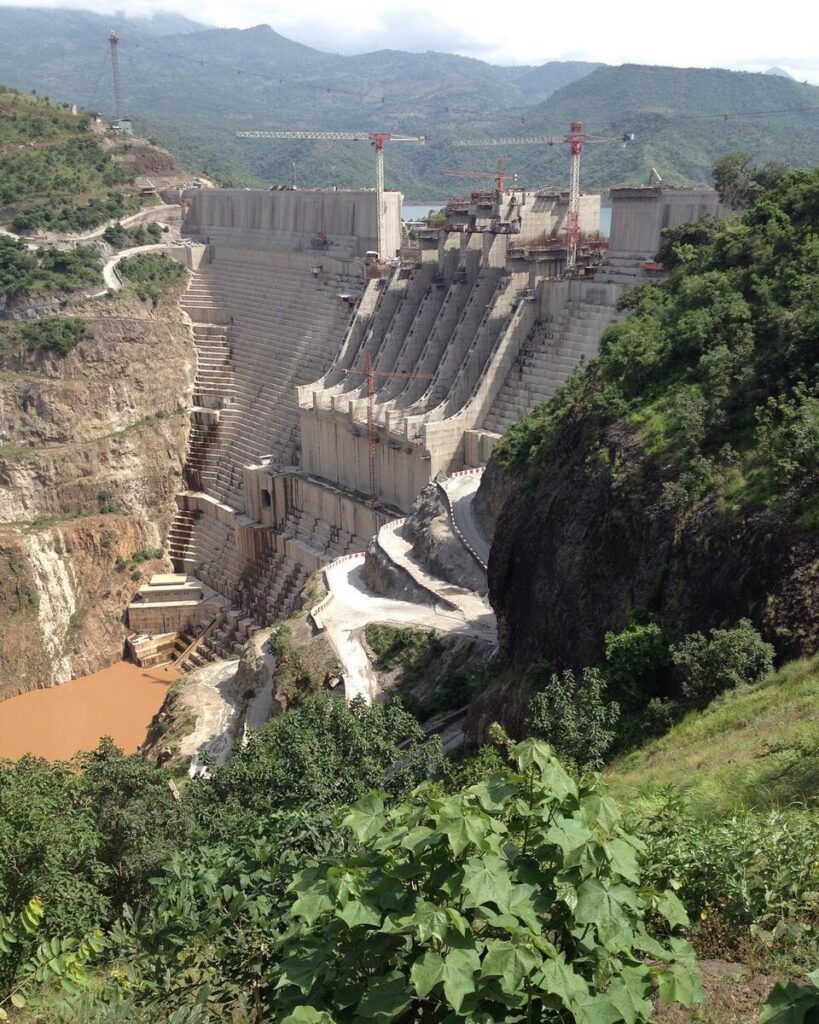
These trade-offs became particularly evident in the large-scale irrigation scheme associated with the dam, which used the regulated flow of the Omo River to support commercial sugar production by a state-owned company. This simultaneously altered the ecological conditions and livelihood systems on which downstream agropastoral communities depended. It also resulted in the displacement of around 2,000 agropastoralists in the lower Omo which further highlighted how the benefits of development can be pursued at one scale while creating social and ecological costs at another.
This tension revealed something that extends beyond a single dam. Large-scale climate and development projects often generate benefits and burdens unevenly. What appears to be sustainable development from one geographical scale may represent dispossession or exclusion at another. Rather than asking whether “development” is simply “good” or “bad”, my research was concerned with understanding how these uneven outcomes are produced and why certain interests consistently prevail over others. But as my research progressed, I found myself confronting a broader puzzle. Why do climate interventions that are explicitly designed to promote sustainability continue to reproduce inequalities?
Beyond the North-South Binary
This question became even more pressing as I expanded my research beyond Ethiopia. While preparing a paper for the 2026 Development Studies Association (DSA) Conference, I realised that many contemporary debates on climate justice rely on a familiar narrative: the divide between the Global North and the Global South.
This framing remains indispensable. There is overwhelming evidence that countries in the Global North bear disproportionate historical responsibility for greenhouse gas emissions, while many countries in the Global South experience the most severe impacts of climate change despite contributing least to the problem.
Yet I increasingly found myself asking whether this binary, important as it is, tells the whole story. The Gibe III experience suggested otherwise. The project has contributed to boosting Ethiopia’s national electricity supply while also affecting local riverine communities whose livelihoods and relationships with the river have been disrupted. The communities most adversely affected by the project were not harmed because they happened to live in the Global South. Rather, they were affected by particular political choices, governance arrangements, and development priorities operating within Ethiopia itself. Likewise, many climate interventions across the world generate winners and losers within countries, across regions, and even within individual communities. The geography of climate injustice is therefore more complex than a simple distinction between North and South.
This does not mean abandoning the North-South framework. Rather, it means recognising its limits.
“If we explain climate injustice only through historical responsibility between regions, we risk overlooking the political and institutional processes that continually reproduce injustice within them. In doing so, we may miss important opportunities to understand how climate interventions are designed, whose priorities they reflect, and whose voices remain marginalised.”
Nigatu Abebe Wolkanto
So, how is climate injustice produced in the first place? Answering this requires looking beyond geographical categories, and towards the governance processes.
Rather than viewing climate governance as simply a matter of coordinating policies or integrating mitigation and adaptation, I am interested in the ideas that underpin these governance arrangements. Every climate intervention reflects assumptions about what counts as sustainable development, which futures should be prioritised, and whose interests deserve protection.
Germany’s energy and mobility transition provides a useful example. The opening of Tesla’s Gigafactory Berlin-Brandenburg in March 2022, can be understood as reflecting a particular development pathway or vision presented as sustainable development. It embodies a sustainability imaginary, in which technological innovation, industrial efficiency, and electrification are understood as means of reconciling economic growth with environmental protection. In this vision, the future to be prioritised is one of continued economic growth, technological progress, and low-carbon mobility, while the interests of industry, investment, employment, and consumers are given priority.
Underlying this vision is an ecomodernist aspiration of creating a “win-win” relationship for economic development and environmental sustainability. This way of thinking has become influential in sustainable-development discussion across platforms such as the European Union, the Organisation for Economic Co-operation and Development, and the United Nations.
But these assumptions are rarely neutral. They shape investment decisions, legitimise particular forms of intervention, and ultimately influence who benefits from the transition to a low-carbon future. For me, understanding these deeper processes is essential.
Sustainability Imaginaries
A missing dimension that is unexplored in many discussions of climate governance is the role of sustainability imaginaries. These are the ideas through which societies imagine development, nature progress, technology and justice. Put simply, sustainability imaginaries are collectively held visions of what a sustainable future should look like, and how that future ought to be achieved. They shape what governments, international organisations, investors, and communities understand as legitimate climate action. More importantly – they influence whose priorities are recognised, which development pathways receive political support, and whose sacrifices become normalised in the name of sustainability.
But what happens to the existing communities, ecologies, and practices that do not fit into the vision. Bresnihan and Brodie show that they are rendered as ‘waste’ or ‘excess life’, remnants of a past economy that must be displaced, managed, or extracted from to make way for a greener energy culture centred on global technology. This case therefore demonstrates how sustainability imaginaries do more than describe possible futures. They actively organise decisions in the present by privileging particular technologies, economic interests, and forms of life while marginalising others.
Thinking in terms of sustainability imaginaries changes how we look at climate action. It shifts attention away from viewing climate interventions simply as technical responses to environmental challenges. Decarbonisation projects, whether hydropower dams, renewable energy parks, carbon offset schemes or critical mineral extraction, are never purely technical projects. They are also political projects, embedded within particular ideas about development, progress, and desirable futures.
These imaginaries may, for instance, orient societies towards reviving long-abandoned or disused sustainable practices, rejecting environmentally destructive industrial models, or embracing green modernisation as a pathway towards a fossil-free future. In each case, however, particular visions of sustainability are privileged over others, shaping what is understood as desirable, possible, and necessary in the pursuit of decarbonisation. This raises an important point: We need to critically scrutinise the notion of “sustainable development” that underpins much of the global climate agenda.
Governance, therefore, is not only about institutional coordination but also about translating these visions into policies, investment decisions, and interventions. The resulting choices that emerge have real consequences for communities and the environment, and raises questions around who benefits, who bears the costs, whose knowledge counts, and whose livelihoods are transformed. These questions of spatial justice are therefore not accidental by-products or side effects of climate action. They reveal the deeper assumptions and priorities that underpin the governance of green transitions.
From Spatial Justice to Sustainability Imaginaries
This perspective also offers a different way of understanding the increasingly important relationship between climate mitigation and adaptation. While existing research often focuses on policy integration and institutional design, less attention is paid to why similar climate interventions produce different outcomes across places and communities.
These differences cannot be understood through governance structures alone; they also reflect the sustainability imaginaries that shape them. Different actors imagine sustainable futures in different ways, and these competing visions influence how climate policies are designed. The mitigation-adaptation nexus is therefore visible not only in policy documents, but in the lived experiences of communities navigating decarbonisation.
Reimagining Climate Justice
In my conference paper at DSA, Beyond north–south binaries: Governance, equity, and the politics of climate mitigation and adaptation, I argued that understanding climate justice requires us to move beyond the familiar Global North-South binary. Instead, we need to examine how different visions or sustainability imaginaries shape climate action governance and why their impacts are felt so unequally.
The paper introduced an evolving conceptual framework for examining these questions across different scales. It looks at how climate injustices are relationally produced, challenging North-South binaries by interrogating how different imaginaries of sustainability, development, nature, progress, technology, and justice shape climate interventions and also looking at who their shaping benefits, who bears the costs, and where new forms of inequality emerge.
The paper drew on a review of the literature on decarbonisation pathways alongside my own experiences. But the conference also pushed me to think beyond sustainability imaginaries as an abstract concept. I left the conference asking: How do these different visions of sustainable futures become visible, contested, and ultimately materialised through climate interventions in very different development contexts?
I also encountered research that approached the global green transition from a more critical political economic lens, examining how decarbonisation is reshaping patterns of extraction, investment, labour, and development across the Global South. These contributions deepened my understanding of the spatial justice dimensions of decarbonisation, particularly by foregrounding colonial legacies, power relations, and institutional dynamics.
This was particularly evident in my panel, “G(local) Political Economy of Green Transition: Actors, Institutions, and Power Shifts,” where Jameela Joy Reyes and Gabriel Mesina (Manila Observatory) examined colonial legacies and power dynamics in the Philippines, while Matthew Tyce (Kings College London) explored the political economy of Mission 300, financialised electrification, and green transition in selected African contexts. Together, these contributions sharpened my understanding of how decarbonisation can both challenge and reproduce existing spatial inequalities and power relations.
The conference also opened up new questions for me, particularly through analysis of the rise of the EU Green Economic Statecraft as the pillar of an emerging “green superpower” by Luis Mah (University Institute of Lisbon) and Luis Pais Bernardo (Lisbon School of Economics and Management), and Japan’s role in shaping Indonesia’s energy transition by Raymond Yamamoto (Aarhus University) and Ruddy Gobel, which sparked my curiosity about the growing intersection between geopolitics and the political economy of the green transition. As competition intensifies over critical minerals, renewable energy technologies, strategic infrastructure, and green industrial policy, climate action is increasingly becoming entangled with shifting geopolitical rivalries and economic interests.
Beyond the Binary: Imagining a Just Transition
These discussions left me thinking more deeply about why some sustainability imaginaries gain prominence while others remain marginalised, and how these broader geopolitical forces shape climate governance across multiple scales.
Moving beyond the North–South binary does not weaken claims for climate justice. It strengthens them by recognising that injustice is produced not only between countries but through the political choices, governance arrangements and competing visions of development that shape green transitions everywhere. The challenge, then, is not simply to accelerate the green transition, but to ask what kind of transition is being pursued? Understanding these processes is essential if climate action is to become not only low carbon, but genuinely just.
About Nigatu Abebe Wolkanto
Nigatu Abebe Wolkanto is an early-career scholar of African Studies at Wolaita Sodo University, Ethiopia. He holds a PhD in Rural Development from University College Dublin, where his research examined the spatial justice implications of large-scale hydropower development in Ethiopia. His research has progressively evolved from examining community resilience and the politics of large-scale infrastructure to exploring the governance of green transitions, climate justice, and the political economy of decarbonisation. He has presented his work internationally, including at the International Humanitarian Studies Association Conference (Paris), the Africa Young Graduates and Scholars Conference (Pretoria), Chulalongkorn University (Bangkok), and the 2026 Development Studies Association Conference (Dublin). His current research investigates how sustainability imaginaries, spatial justice, political economy, and geopolitics shape climate governance and green transitions in the Global South. His work has been published in Energy Research & Social Science and Development in Practice.