Thirty-one years after the Oslo Accords, the agreement that set out the terms for Palestinian sovereignty, including the right to develop their own separate and independent communication systems, the infrastructure remains unfulfilled. In the Palestinian Territories, where people face ongoing and chronic displacement, reliable mobile connectivity is essential. Yet significant barriers continue to limit how networks are planned, built, and operated. While the 5G rollout progresses steadily in Israel, 2G in the Gaza Strip and 3G in the West Bank are the mobile technologies available to the Palestinian population. Simona Bonardi, Technologist and AI Ethicist, asks why.
(Names have been changed to respect anonymity).
The crowing of the rooster in the middle of our conference calls has become a familiar sound.
M. lives in the Gaza Strip. He travels daily to an Internet point where he studies and works.
“You need structure in the chaos to keep your sanity,” He explains.
M. is not the first person to tell me this – like many, each morning M. continues to get up, wash and go out, in an attempt to keep his mind busy throughout the day. Beyond electricity and connectivity, the Internet point gives structure to an existence that is being reduced to dust.
I struggle to picture the space that M. sits in. A white curtain flapping behind him replaces the missing wall. His laptop camera is damaged, so all I can see is his faded image on a white ghostly background. A cobweb of extension plugs within a shell of a broken building is M.’s working space.
The crow of the rooster sounds out again, cutting through my thoughts.
“It belongs to the family that runs this place,” M. tells me.
“They run an Internet point and have a farm?”
“No, just the one rooster,” He laughs.

No Signal Found by epicfail23 (Source: deviantart.com)
For many of us, the COVID pandemic was a painful exercise of forced social isolation, made more tolerable only by digital connectivity, the one lifeline whose economy blossomed while countless businesses shut down.
It was not a hard time for me – well acquainted with technology, on which my livelihood depended, and solitary by nature, bar a few close friendships that had survived my many migrations thanks to the wonders of the Internet.
Two decades earlier I had chosen to work in telecommunications based on the romantic notion that my work would enable people to communicate, learn, or simply call for help in times of emergency. Our dystopian present renewed my motivation.
Yet technology (its use and governance, who is granted or denied access) contributes to cementing or eroding social significance; its widespread availability and democratisation act as a mirror – exposing privilege gaps, and encouraging us to question who these systems serve.
My first opportunity to study a real-world case of how power is exerted through technology came last year, when a friend forwarded me a call for proposals by 7amleh (The Arab Centre for the Advancement of Social Media) for the 2025 forum “Disconnected: The Impact of War on Internet Access and Palestinian Digital Rights”, their ninth annual Palestine Digital Activism Forum.
It was the first time that my profession would serve as a lens to analyse a complex political situation. I learnt that the Gaza Strip and the West Bank were using severely outdated mobile technologies, although not equally old, in the two regions – an oddity in itself. Technologies so obsolete that I could barely remember how they worked – so far were they from the latest devices created over three decades of advancements in the field.
With the help of expert colleagues, my preliminary study outlined the staggering societal costs of employing outdated mobile technologies. I had barely scratched the surface, but enough to submit my proposal to 7amleh.
The research that followed, a time travel through the five generations of mobile communications, later presented at the forum, is one of my favourite examples of what technology-enhanced human collaboration can achieve.
In the early 2000s, countries’ technological landscapes were changing at different speeds and implementing different standards. I remember my second-generation (2G) bulky mobile phone being unable to connect to the local 3G network when I first landed in Japan. It was a reliable device, with a battery that was never low and SMS memory that was always full, and it served me well (in Europe) until my first smart phone. By then, we were online all the time, at home and on the go, managing almost every aspect of our lives through a single wireless device. Looking back, it feels odd that a different way of functioning ever existed.
Now, throughout the day, we switch between mobile and fixed networks almost seamlessly, based on convenience and situation. We expect high-speed connectivity no matter where we are and regardless of the application we use. Without realising it, we continue to fuel the main driver of the so-called fixed-mobile convergence – the technology that enables the transport of both our fixed and mobile Internet traffic over the same core network. Whether we connect to the Internet using a cable, WiFi, or mobile signal, the first leg of the data journey transports our traffic towards the same high-speed “motorway”, backbone and brain of the telecommunications system.
Mobile networks (also known as cellular networks) rely on antennas geographically distributed over the area they serve. The territory is divided into smaller sections called “cells,” each served by dedicated antennas. As we move, our active connections are handed over between cells to keep the service continuous.
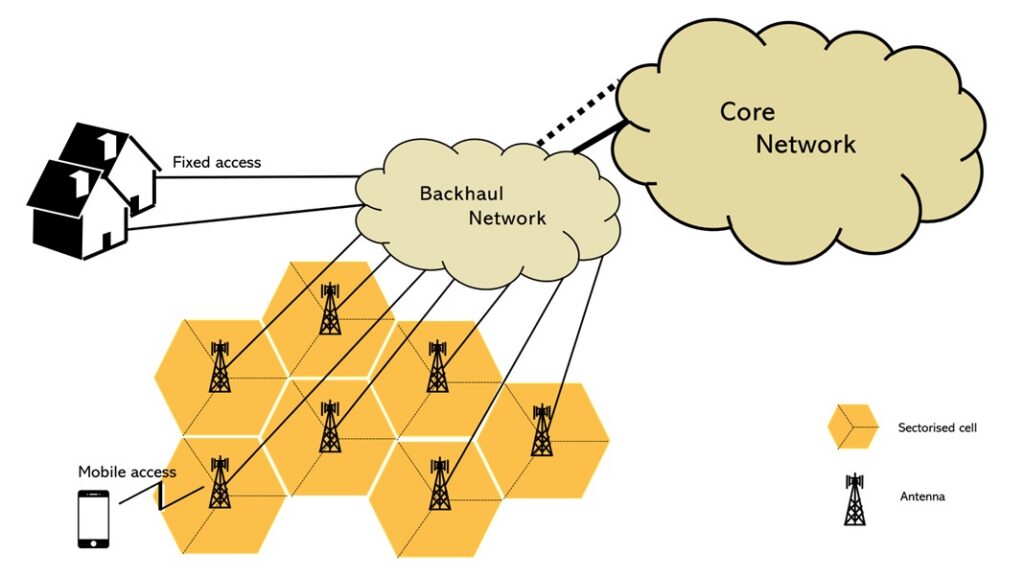
Simplified model of fixed and mobile networks showing the shared backhaul (connecting the fixed and mobile accesses to the core network) and core (also known as backbone, brain of the telecommunication system). Illustration by Simona Bonardi.
Mobile networks are engineered to achieve maximum performance while keeping both cost and interference to a minimum. They are sized based on expected traffic, number of active users, target data speeds, and the geography of the area served. While the physical infrastructure sets an upper limit on capacity, the network is dynamic and can be adjusted to handle traffic spikes generated by crowded scheduled events, such as festivals, major sports games, or political rallies.
Network planning and operations depend on reliable historical population data and subscriber density metrics, but network performance relies on how accurately predictive models represent real-world network usage. Chronic population displacement is one example where models fail, and while advanced configurations and adaptive governance can help mitigate performance drops, the service quality remains highly unreliable, making continuous technological upgrades essential.
The Occupied Palestinian Territories fit such a profile, with frequent displacements of varying intensity occurring in both the Gaza Strip and the West Bank. In Gaza, displacement is mostly due to bombardments, evacuation orders and localised weather events, while in the West Bank structural demolitions and settlement expansion are the main factors. As people are forced to move, fixed Internet options become limited or absent, making mobile networks the primary option, and as a result, chronically undersized.
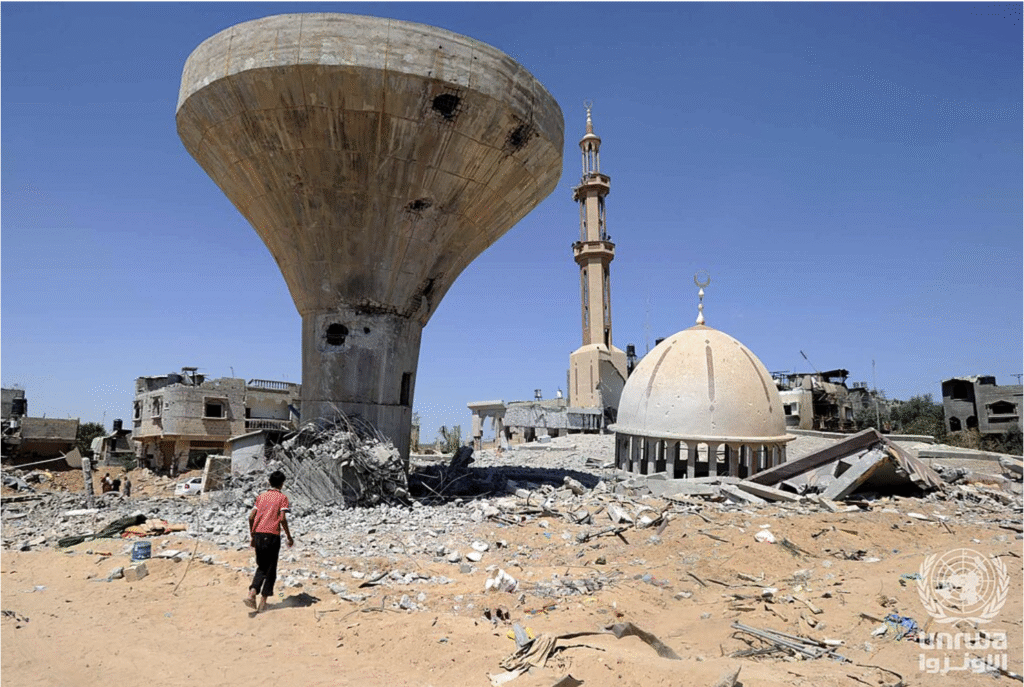
A child walking in front of a collapsed mosque and a water tower in Khuza’a, Gaza Strip | Openverse. Image sourced by Simona Bonardi.
To access connectivity, individuals face dangerous commutes to reach Internet points, mobile hotspots, border regions (for foreign signal “spillover” or roaming through mobile plans of donated eSIMs, electronic SIM cards purchased abroad and sent to the people in Gaza through activist networks such as Connecting Humanity). With Palestinians increasingly relying on Internet access as a critical lifeline for education, work, commerce, and social relationships across geographic and political divides, digital isolation means far more than a communication blackout.
Contrary to their needs, and despite the 1995 Oslo Accords recognising the Palestinian right “to build and operate separate and independent communication systems and infrastructures,” the Palestinian Territories continue to face a chronic technological access delay imposed on them.
According to Annex III, Article 36 on Telecommunications of the Oslo Accords, the release of radio frequencies to Palestinian operators depends on Israel’s approval, granting Israel significant power to delay any Palestinian effort towards telecommunications development indefinitely. In addition, Israel imposes restrictions on Palestinian imports of hardware material and civil devices, thereby limiting access to both infrastructure ingredients and smart phones.
As of 2016, a time when the MENA region was moving towards 4G and Israeli operators ran 3G and 4G networks, the Palestinian operators Jawwal and Ooredoo Palestine (formerly Wataniya Mobile) were still waiting for the release of 3G frequencies which had been requested eight years prior. In its assessment of the telecommunication sector in the Palestinian Territories that same year, the World Bank estimated that the Palestinian mobile operators lost between US$436 and US$1,150 million between 2013 and 2015. The majority of such losses could be directly attributed to the lack of 3G services and to the unauthorised competition of Israeli operators in the Palestinian Territories. As of October 2023, while Israel was decommissioning their own 2G and 3G networks in preparation for the 5G rollout, Palestinian operators were still restricted to 2G in the Gaza Strip and to 3G in the West Bank – a persisting technological divide that echoes and amplifies the populations’ geographical fragmentation.
The evolution from 2G to 5G, spanning about three decades, saw a new mobile generation every ten years. In the early 1990s, 2G represented the first digital mobile technology, leaving behind the analogue telephony of the first generation. It supported only voice calls and short text messages (SMS), and was followed in the early 2000s by 3G, which introduced practical mobile internet access and enabled the rise of social media. Around 2010, 4G brought much faster mobile broadband speeds, helping launch commercially viable IoT (Internet of Things), a technology that enabled the communication among devices.
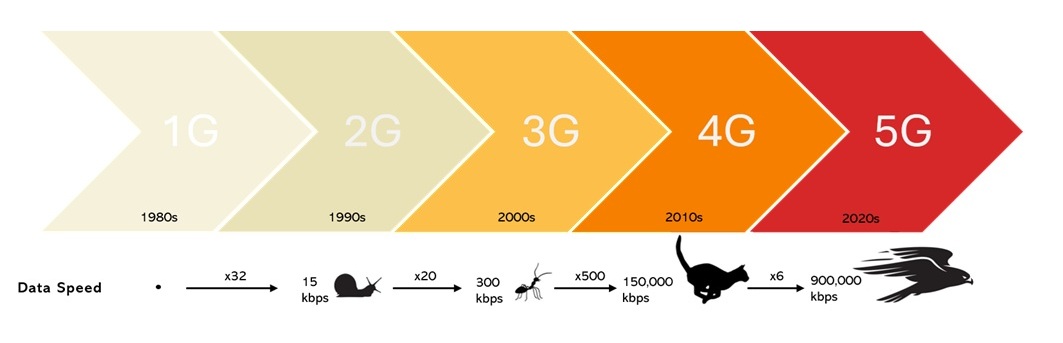
Evolution of mobile generations and data speeds over time. Palestinian operators are still restricted to 2G in the Gaza Strip and to 3G in the West Bank. Note: the data speed values in the image are indicative and tend to vary based on network implementation within each generation and multiple network factors, including geography, copresence of multiple generations of infrastructure, network configuration, and runtime variables such as current data traffic and distance from the antennas (affecting the signal strength). Illustration by Simona Bonardi.
With data rates that are more than 100,000 times those available with 2G, the more recent evolution to 5G goes well beyond the traffic speed, towards the vision of “a fully mobile and connected society”. A paradigm shift from the previous generations, 5G is the first standard conceived with the goal of connecting entire industries and complex digital ecosystems through “a cloud-native business model, architecture, and operation”. While smartphones continue to evolve in their role as main personal devices, the number and types of personal devices (such as wearables or sensors) will increase. The boundaries between personal and enterprise network usage are destined to blur, introducing unprecedented security and privacy challenges. Enabling data-intensive applications where not only humans, but also heterogeneous internets of devices can exchange heavy data (such as live streaming) with near-instant response, applications such as hybrid live performances, autonomous driving, remote surgery, high-precision manufacturing, military operations and advanced cybersecurity, become possible.
Seen in this light, the lasting technological development deficit resulting from the imposed restrictions on the Palestinian Territories affects all aspects of society, at both local and international levels – from politics, economy, education, academia and research, to the exercise of civil liberties, social fabric, culture and identity. These limitations are compounded by other forms of control and surveillance allegedly tied to Israeli security grounds, affecting the routing and processing of communications data within the Palestinian Territories and internationally. Notable examples include the requirement for all Palestinian operators to route their international communications through Israeli gateways, and, favoured by the technological vulnerability of 2G, the reported and systematic large-scale collection of intercepted Palestinian communications in the Gaza Strip for use in AI training.
In his 2011 report, former UN Special Rapporteur on the promotion and protection of the right to freedom of opinion and expression Frank La Rue highlighted the key role of the Internet in enabling human rights and human progress, calling for “as little restriction as possible to the flow of information via the Internet”. He reminded all States that “the full guarantee of the right to freedom of expression must be the norm, and any limitation [to be] considered as an exception, and that this principle should never be reversed.” La Rue further emphasised that protection of national security or counter-terrorism concerns cannot be used to justify restricting the right to expression,” calling on States “to ensure that Internet access is maintained at all times, including during times of political unrest”.
Analysed through this lens, Israeli-imposed connectivity and electricity blackouts reveal effects that extend beyond temporary service disruptions. The destruction of vital telecommunications infrastructure and the blockade on fuel supplies that could enable the operation of backup generators limit people’s ability to communicate and access information, enforcing social isolation and amplifying psychological trauma.
These restrictive measures are not new – they predate the 2023 escalation. Taken together with the longer-term technological restrictions, they contribute to the creation of a permanent social and digital divide.
Social fragmentation and forced isolation destroy the political sphere of human life; through the loss of experience and relationship with the world, they pave the way for the loss of one’s own self and identity. “Self and world, capacity for thought and experience are lost at the same time,” writes political theorist and philosopher Hannah Arendt in her work The Origins of Totalitarianism (1951). When our social connections are ruptured, we are left feeling uprooted, detached, and estranged. Our social support networks protect us and anchor our sense of self; without them, we become physically and mentally vulnerable, a state that is well documented in scientific literature as a predictor of poor health and premature death.
The systematic destruction of all paths of connection, both physical and virtual, disrupts all dimensions of the social connection experience: number and types of relationships and roles, frequency and duration of the interactions, their quality, and the support exchange that they enable. Individuals are silenced; and communities wither.
It is hard not to read in this engineered demolition of the individual, the large-scale design to erase a people. It leaves me with certain clarity on the importance of reclaiming our agency, and the necessity to continue to build bridges. So, perhaps my unlikely encounter with M. over a feeble Internet connection, with the soundtrack of a rooster and the heaviness of feeling watched, scores a point against erasure, for M. and me, and for the endangered “we” of our shared humanity.
Further Reading
- Logistics and Telecommunications Cluster (LTC Telecoms) Palestine – Gaza Strip Conflict Factsheet: August 2026 – occupied Palestinian territory | ReliefWeb – a 2-page document exploring telecommunications and connectivity in Gaza as of August 2026, highlighting key needs, disruptions, and humanitarian communications activities.
- Keep Gaza Connected – Gaza online aims to deliver independent, crisis-resilient connectivity for Gaza, while enabling a broader ecosystem of civil society, institutions, and global participants through accessible, scalable digital infrastructure.
- Crips for eSims for Gaza – a collaboration between Jane Shi, Leah Lakshmi Piepzna-Samarasinha, and Alice Wong for disabled people around the world to raise funds to get as many eSims as we can into Gaza.
- Palestine – Conflict LTC Situation Report (Telecoms Area) #72 (Reporting Period: August 2026) – occupied Palestinian territory | ReliefWeb – a more detailed Situation Report providing a monthly update on LTC telecoms activities.
- Palestine Conflict Emergency | ETC Operations – an overview of the Emergency Telecommunications Cluster’s response in Gaza
- Reconnecting Gaza, Empowering the Future from 7amleh – information on a civil-society campaign framing the restoration and rebuilding of Gaza’s telecommunications infrastructure
- The Impact of the Gaza Blockade and the Destruction of Telecommunications Infrastructure on the Digital Economy Amidst Genocide (December 2025) – a 7amleh research resource examining the damage to Gaza’s telecommunications infrastructure and its wider humanitarian and human-rights consequences.
- Gaza’s Telecommunications: Occupied and Destroyed – a policy analysis that situates the destruction and disruption of Gaza’s telecommunications within the longer history of Israeli control over Palestinian digital infrastructure, while examining its humanitarian, economic, and political consequences.
- Interactive mobile coverage maps of the Palestinian Territories:
About Simona Bonardi
Simona Bonardi is an IT engineer and governance professional specialised in data and AI. Driven by a passion for language in all forms, she works with words, numbers, and illustrations to craft stories about the human experience, animal encounters, and dystopian futures. Her research focuses on interdisciplinary topics, and includes Posthumanism, AI ethics, knowledge and pedagogy, propaganda and persuasion.