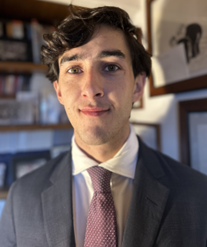
While the Philippines presents itself internationally as a democratic partner, its domestic reality tells a different story — one marked by red-tagging and intimidation. In this piece, geopolitical analyst Tommaso Franco explores the “Manila paradox” and the growing pressures faced by activists, journalists, lawyers, and ordinary citizens across the country.
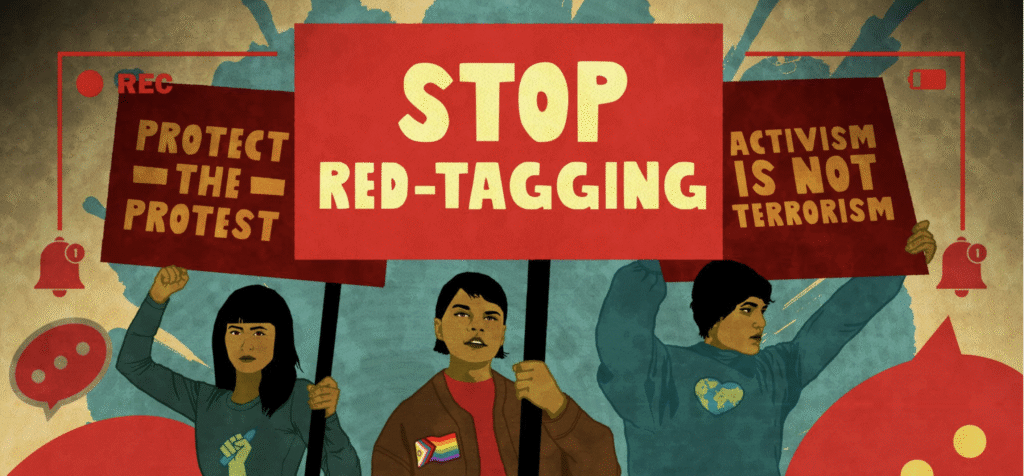
Image by Rebecca Hedin, sourced from Amnesty International
In 2026, the Philippines chairs the ASEAN (Association of Southeast Asian Nations) under the slogan “Navigating Our Future, Together”. While the regional bloc presents itself as a force for unity and stability across Southeast Asia, the Philippine government’s credibility is increasingly challenged by its continued use of red-tagging — the systematic labelling of activists, journalists, lawyers, and government critics as “terrorists” or “communists”.
As Cristina “Tinay” Palabay, Secretary General of Karapatan, a Philippine human rights alliance, explains, the practice of red-tagging “targets journalists, activists, lawyers and unionists”, and often results in violence. Since 2016, over 72 union leaders have been killed, and the Philippines also holds the highest record for activist abductions in Asia with at least 32 documented cases. Fear of reprisal is widespread, with the majority of the Philippine population considering it extremely dangerous to criticise the government.
The UN Special Rapporteur on freedom of opinion and expression, Irene Khan denounced the practice in their World Report 2024: “Vilification suppresses freedom of expression and sows distrust between the State and citizens”. Increasingly, these tactics are amplified through digital technologies, contributing to a broader “chilling effect” in which individuals self-censor to avoid harassment or worse. The scale of this human rights crisis is systemic.
In 2025, over 1.750 violations were recorded, with more than 99% of these attacks linked to red-tagging. There have been over 900 victims in the last six years. These violations primarily manifest in three ways: digital profiling and hate campaigns, judicial harassment through trumped-up charges, and physical surveillance that often leads to enforced disappearances. This crackdown stems from a state policy that views democratic dissent as a direct link to armed insurgency.
How the Philippines manages this erosion of civil liberties during its ASEAN chairmanship will be critical, shaping whether Manila becomes a model of moral leadership in the region or an exportable brand of digital authoritarianism.
Historical roots: from the legacy of McCarthyism to Philippine Martial Law
The phenomenon and practice of red-tagging draws on a longer history of anti-communist repression. The logic is inherited from the “Red Scare”, born out of the communist threat following the 1917 Russian Revolution and later in the 1950s American McCarthyism, a campaign led by senator Joseph McCarthy that was a violent witch-hunt against activists and academics.
For decades, the Philippines served as a testing ground for anti-communist tactics. As early as the CAFA (Committee on Anti-Filipino Activities) in the early 1960s, the state cataloged journalists as public enemies, which ultimately fueled further protests.
This further intensified under Ferdinand Marcos Sr.’s Martial Law, established on September 21, 1972, marking a dark chapter in Philippine history defined by totalitarian civilian control and systematic human rights violations (including the torture, enforced disappearance and extrajudicial execution of tens of thousands of people). The campaign was framed as a way of annihilating the threat of the New People’s Army (NPA), the armed wing of the Communist Party with the line between armed insurgency and peaceful dissent was deliberately erased, leading to thousands of cases of torture and killings. The rhetoric of “national security” used to justify widespread repression and was weaponised to imprison over 50,000 citizens.
Duterte and the institutionalisation of repression under the NTF-ELCAC task force
Today, under Marcos Jr., repression has been institutionalised through the NTF-ELCAC (National Task Force to End Local Communist Armed Conflict). It was created in 2018 by the new president, Roberto Duterte as a “whole-of-nation” approach to counter community insurgency and promote socio-economic development.
In practice, however, it operates as a social control mechanism that criminalises dissent. Organisations such as Amnesty International accuse it of using massive budgets for online smear campaigns and arbitrary detentions, facilitated by the 2020 Anti-Terrorism Act (ATA), which permits prolonged detention of suspects without formal charges. The NTF-ELCAC task force has also been accused of red-tagging by frequently sharing Facebook posts portraying young activists as terrorists. UN experts like Irene Khan and groups such as the Philippine human rights alliance, Karapatan are calling for its immediate dissolution.
“I fear I could be killed”: measuring activism by the weight of intimidation
Karapatan is a Philippine human rights alliance that documents state abuses and serves as a primary advocate for victims of red-tagging, while frequently being targeted by the same practice due to its vocal dissent. For activists like Cristina Palabay, the “communist” label is the first act of a tragically predictable script. First comes the intimidation – “Someone called me […] to tell me that, before being killed, I might end up being raped”. This is followed by physical surveillance and, “The next step”, Cristina explains “is fabricated charges or execution”.
The story of Zara Alvarez, an activist and paralegal for Karapatan, is emblematic of the dangers faced by human rights defenders in the Philippines. After years of persecution because of her commitment to advocating for the farmers of Negros Island, located in the Western Visayas region. Known as the “Sugarbowl” of the Philippines, Negros Occidental produces more than half the nation’s sugar output. It is an island historically dominated by vast sugar plantations and a deeply unequal social order dominated by wealthy landowners and impoverished farmers.
Zara worked tirelessly to support landless farmers and agricultural workers in their demands for real agrarian reform, helping them resist exploitation by powerful landowners. Through her activism, she broke the silence on rural abuses, making her a direct target for those who wanted to maintain the island’s feudal status quo. Before her death in 2020, she had sought legal protection by reaching out to the courts to appeal: “I could be killed”.
Despite repeated intimidation and detention, Zara never stopped her work. Shortly before she died, she declared: “No matter how many times they lock me up or threaten me, they will not stop me”. Her death represents the thirteenth murder of a Karapatan worker under the Rodrigo Duterte administration.
Following her death in 2020, the violence against activists intensified significantly. By the end of Duterte’s presidency in June 2022, Karapatan had documented a staggering total of 422 murders of human rights defenders. Tragically, this pattern of systemic violations and repression has shown no signs of abating, continuing steadily under the subsequent administration.

From Corrales to Cumpio: Press Freedom Under Threat
Press freedom and access to information itself is increasingly under threat in the Philippines. Many journalists have ended up on proscription lists, subjected to threats, and accused of links to insurgent groups. Cong Corrales, editor of the Mindanao Gold Star Daily, a newspaper in the southern Philippines, recalls: “They said there was a one-million-peso bounty on my head”.
Lady Ann Salem, widely known as “Icy” and editor of Manila Today, turned her 2020 arrest into an opportunity to investigate prison conditions. Her delayed and obstructed release prompted the Committee to Protect Journalists (CPJ) to denounce the case as a crime against press freedom. Reflecting on her experience, she told a journalists’ union: “Thank you for not treating me like a criminal” adding that the “the oppressed must be given a voice so that journalists can work without fear”.
Members of the judiciary in the Philippines have also been intimidated. Monique Quisumbing-Ignacio, the judge who dismissed Salem’s case that the government attempted to reopen in 2024, has also been targeted by red-tagging.
This contradiction between democratic institutions and state repression is perhaps most starkly illustrated in the case of Frenchie Mae Cumpio, a young investigative journalist arrested in 2020 on charges deemed politically motivated by organisations such as Amnesty International and the International Federation of Journalists. Her conviction in January 2026 which resulted in sentencing of up to 18 years in prison, confirms that the persistence of the repressive state practices remains intact despite the recent change in government in May 2022.
“I dream of men breaking down the gate”: the broken voices of Philippine trade unionism
Within the world of labor movements in the Philippines, red-tagging has created an environment so hostile it is forcing entire organisations to dissolve simply to survive. Noel Baron, President of union at Ebara Pumps (a domestic manufacturer of water pumps) reports: “They want to convince us to leave the union. Many have quit; only two of us are left”.
Jerome Adonis, who is Secretary General of the labour federation Kilusang Mayo Uno (KMU) has seen 72 members killed since 2016. He argues that “the government uses red-tagging to prevent us from organising and unionising”.
Union leaders also describe deliberate efforts to isolate labour organisations. Oliver Muya, the Vice President of the Union for Nexperia which is a semiconductor manufacturer headquartered in Nijmegen in the Netherlands, explains : “They are trying to isolate the KMU to make it easier for them to dismantle the union”. Mylene Cabalona, President of the BPO Industry Employees’ Network of the Philippines, has also received online threats after various police-linked social media pages shared BPO pages.
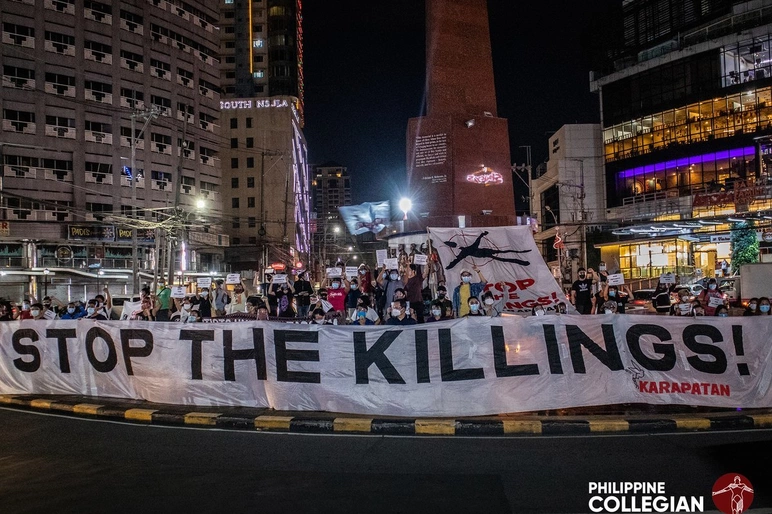
This climate of repression and violence culminated in tragic events like the “Bloody Sunday” in 2021. Following President Duterte’s public order to “finish off” communist rebels, a series of simultaneous raids in the Calabarzon region (in southwestern Luzon, the main island in the Philippines) resulted in the deaths of nine activists, including labour rights such as activist Emmanuel Asuncion, known as “Manny”. Authorities claimed the victims were in possession of illegal firearms claiming that they were “subversive elements” who had resisted the searches with weapons, a common justification known as nanlaban. However, international human rights groups like Karapatan and the United Nations condemned the operation, alleging the victims were unarmed and that evidence had been fabricated.
The price of justice: “Challenging the powerful makes me a target”
Nearly 90 legal professionals have been killed since 2007, while more than 200 others have escaped ambushes or continue to face constant threats and intimidation. Among those at risk are Maria Kristina “Krissy” Conti, Secretary General of the National Union of Peoples’ Lawyers (NUPL). She has been a key figure in representing victims before the International Criminal Court, which recently confirmed its jurisdiction in the case against former Philippine President Rodrigo Duterte, paving the way for proceedings concerning alleged crimes against humanity linked to the “war on drugs”.
Because of her work, Krissy has been labeled a “political operator” for rebel groups, an accusation widely understood as part of broader “red-tagging” practices. Despite being recognised in 2025 as one of “The Outstanding Women in the Nation’s Service” for her courage, she continues to live under constant threat. “Handling cases against powerful politicians in the Philippines makes me a target” Kristina explains. Kristina dismissed the allegations against her, arguing instead: “The intention is to distract us from the mass killings. I couldn’t remain silent”.
A glimmer of hope emerged in 2024 with the Deduro v. Vinoya ruling. In 2020, Siegfred Deduro, an activist filed a writ of amparo after alleging that military officers under the command of Major General Eric Vinoya had red-tagged him and accused him of links to the Communist Party of the Philippines – New People’s Army (CPP-NPA). This ruling transformed red-tagging from a controversial political practice into a legally recognised actionable wrong. For years, Philippine authorities had denied the existence or danger of red-tagging, often arguing that the practice lacked a legal definition. The Supreme Court of the Philippines addressed this decade-long regulatory vacuum by defining red-tagging as the use of threats and intimidation to discourage activities labelled “subversive”. In doing so, the Court prevented state officials from evading accountability through the absence of legal terminology.
As Ephraim Corte, president of the National Union of Peoples’ Lawyers (NUPL), states: “Now victims can seek protection without waiting to be abducted or killed”. The Court recognised that labelling someone as a communist or terrorist inherently exposes them to real danger, making that individual a target for state agents, paramilitary groups or vigilantes. By considering red-tagging as a violation of the right to life and security, this ruling established a legal basis for victims to seek protection through a writ of amparo. Previously, many lower courts had rejected these requests, claiming that red-tagging did not constitute a concrete threat to life.
The impact of this legal shift is already extending beyond physical protection. Courts have begun ordering red-taggers to pay damages to victims. A notable example is broadcast journalist Atom Araullo, who was awarded over 2 million pesos in 2024 in a libel suit, citing this precedent, ruled that red-tagging is inherently malicious.
White ribbons wave: the people’s resistance
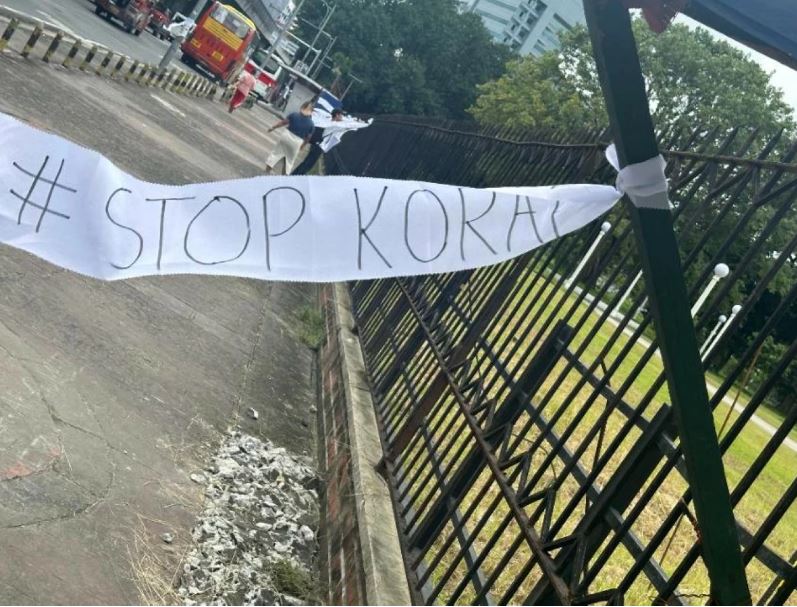
Between 2025 and 2026, public discontent in Manila spiralled leading to massive mobilisations against corruption and repression. Protest symbolism played a central role during this period. This was seen in the thousands of white ribbons appearing in front of the House of Representatives in Manila. The ribbons evoked the spirit of the 1983-1986 People Power Revolution that led to the fall of Marcos Sr. Public. Public anger was also evident in the “Baha Sa Luneta 2.0” protest in 2025, where an estimated 650,000 people demonstrated against the scandal of funds embezzled from environmental security through so-called “ghost” projects.
At the same time, labour unions and social movements in many areas across the country documented the discovery of mock coffins addressed to activists – acts widely interpreted as a form of psychological threat and pointing to the suspected involvement of the NTF-ELCAC.
Organisations such as the International Labour Organization (ILO) and the UN, have supported technical cooperation programmes and initiatives aimed at safeguarding freedom of association, and to counter systematic human rights violations.
A facade of democracy? The Philippines tested by international partners
Manila is actively seeking to attract investment from the EU and is also strengthening its ties with Japan, the USA, and South Korea. In doing so, it positions itself as a better alternative to authoritarian neighbours like Myanmar, who have been under a military junta since the 2021 coup and Cambodia, widely considered a consolidated autocracy with little to no viable political opposition. However, this international image contrasts with the internal reality of repression. The Philippines ranks 116th out of 180 countries in the global press freedom index, indicating the significant lack of media independence and freedom of expression.
International watchdogs such as Amnesty International and Human Rights Watch have questioned the country’s ability to exercise credible democratic leadership in the region. In this context, there is increasing emphasis on the need for stronger international accountability mechanisms. For example, to improve how human rights compliance is monitored using economic clauses such as the EU’s Generalised Scheme of Preferences Plus (GSP+) incentives for sustainable development and good governance. Without a firm scrutiny and condemnation from the international community, as Cristina Palabay emphasises, “it would become complicit in the failure to defend human rights”.
The ‘Manila paradox’ – where democratic institutions coexist with the systematic violent silencing of dissent – is not simply a local anomaly, but part of a broader global pattern of repression in which governments increasingly frame dissent as a security threat. Similar stigmatisation and patterns exist in Colombia and Brazil, where environmental defenders are branded “enemies of development” to justify their elimination. It is also seen in India, where the Narendra Modi government uses “anti-national” labels and the UAPA (Unlawful Activities Prevention Act) to detain intellectuals and activists without trial. Even in established democracies like France and Germany, climate movements (including Dernière Rénovation or Letzte Generation) are being dismissed as “environmental terrorists”.
The Philippine struggle therefore serves as a universal warning: when the language of national security stifles dissent, democracy itself is at risk. International solidarity is the only way to break and challenge this isolation. The climate of fear extends beyond activists and journalists. A Filipino business owner contacted for this article declined to be interviewed, explaining that many entrepreneurs “try not to get involved or be vocal about political stances,” describing this silence as a “sad truth” despite widespread frustration with the government. His response illustrates the real fear that Filipino people face when speaking about these issues.
As a reader, there are ways to take concrete action by signing Amnesty International’s ‘Protect the Protest‘ petition or by supporting Global Witness campaigns. Protecting information is equally crucial: contributing to the ‘NO TAG: Press Freedom for Pluralism’ project by the National Union of Journalists of the Philippines (NUJP), Rappler or Karapatan, helps ensure that state violence and repression remain visible internationally rather than ignored.
As an analyst focused on the intersections of power geopolitics and human crises, the ‘Manila paradox’ represents a crucial nexus that moves me deeply, both intellectually and politically.
From an intellectual standpoint, this crisis challenges traditional models whose high-level data often ignore the reality on the ground. This case demonstrates how democratic institutions can be hollowed out from within and weaponised as a facade for digital authoritarianism, proving that human rights violations are now the true engine of global instability.
While on a political level, the criminalisation of dissent through red-tagging serves as a global warning. If this model consolidates during the Philippines’ ASEAN chairmanship, it will offer a dangerous roadmap to other regimes. The real political battle of the century will be fought over the international community’s ability to shine a light on Manila and acknowledge these invisible conflicts.
About Tommaso Franco
Tommaso Franco is an emerging Rome-born geopolitical analyst, a member of the IISS and Chatham House, and a Junior Fellow at the Swiss Institute for Global Affairs (SIGA). He cut his teeth at Limes, Italy’s premier geopolitical review, where he mastered the art of power before it hit the headlines. An active contributor to various international and Italian outlets (The Australian Institute of International Affairs, The Global Policy Journal, Limes, The European Sting and Notiziegeopolitiche.net), Tommaso holds a Master’s in International Relations (MA in European Studies) from Luiss University, Rome, where he refined his ability to transform complex data into strategic on-the-ground intelligence. Specialising in Asian friction points and human rights, Tommaso combines strategic intelligence with volunteer work and a deep commitment to underreported and challenging social realities (like Scampia, Naples), redefining how we see the world’s most invisible conflicts.