Every year, Central Asian Survey awards The Irene Hilgers Memorial Prize to a junior scholar, who has published an outstanding article in the journal volume from the preceding calendar year. This year’s award recipient is Leora Eisenberg, a PhD student who is studying Central Asian Soviet history at Harvard University, for her article ‘I became an Uzbek’: Jewish-Uzbek encounters in World War Two evacuation.
“During my dissertation fieldwork in 2024–2025, I was repeatedly struck by how often people reflected on the significance of growing up in environments that were so multiethnic. This was often punctuated by mentions of how much they missed this in the present day.”
Leora Eisenberg

Leora’s article looks at the complex encounters between Jewish evacuees and Uzbek communities during World War II, challenging the idea that relations were either harmonious or hostile. Drawing on oral histories from 122 Ashkenazi Jewish evacuees’ to Uzbekistan, newspapers, and archival sources, her article shows that cooperation and antisemitism existed side by side across all levels of society. By examining how people shared knowledge, formed connections, and sometimes pushed back against prejudice, Leora reveals how everyday interactions became a real test of the Soviet ideal of the “friendship of the peoples.”
The judges, Karolina Kluczewska, Edward Lemon and Maia Barkaia commended the article which masterfully combines oral histories against the backdrop of macro history, while openly acknowledging the ambiguities of possible interpretations. They emphasised how the piece adds to our understanding of interethnic relations in the USSR beyond the usual binary of two narratives: either the ‘friendship of nations’ discourse or cultural hierarchies (in this case, antisemitism).
The judges were also impressed with Leora’s writing style. Written during the second year of Leora’s PhD, the article was published the following summer after her third year. We asked Leora:
What inspired your research?
“I wrote this article at a moment when I was still searching for the focus of my dissertation. After setting aside two or three earlier ideas, I found myself feeling completely stuck. This paper became a way to test out a new area of interest—approaching my work as a Soviet historian through the lens of Central Asian Jewish history. At the same time, given my maternal family are nearly all musicians (myself included), incorporating the history of cultural production felt like both a natural and necessary decision.”
And why the research is so important right now?
“It is easy to overlook just how deeply multiethnic Central Asia was—and, in some places, continues to be—amid our focus on the rise of nation-building and post-Soviet nation state What’s remarkable, though, is how fundamental this is to how so many Central Asians understand their identities. During my dissertation fieldwork in 2024–2025, I was repeatedly struck by how often people reflected on the significance of growing up in environments that were so multiethnic. This was often punctuated by mentions of how much they missed this in the present day.”
Leora’s article ‘I became an Uzbek’: Jewish-Uzbek encounters in World War Two evacuation has been made free to access until April 2027.
Browse past award-winning papers on The Irene Hilgers Memorial Prize page.
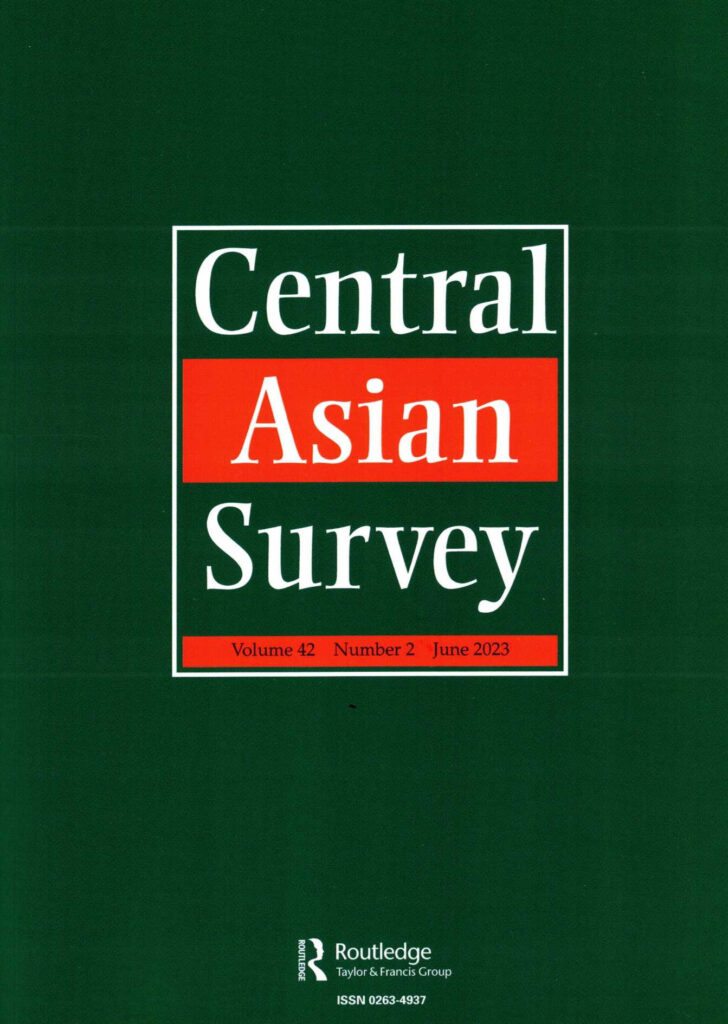
Central Asian Survey: Call for Papers
Central Asian Survey is the only established peer reviewed, multi-disciplinary journal in the world concerned with the history, politics, cultures, religions and economies of the Central Asian and Caucasian regions. These include primarily the republics of former Soviet Central Asia and the South and North Caucasus. Also covered are Chinese Xinjiang, Mongolia, Afghanistan, Iran and Turkey inrelation to their links/policies vis-à-vis Central Asia.