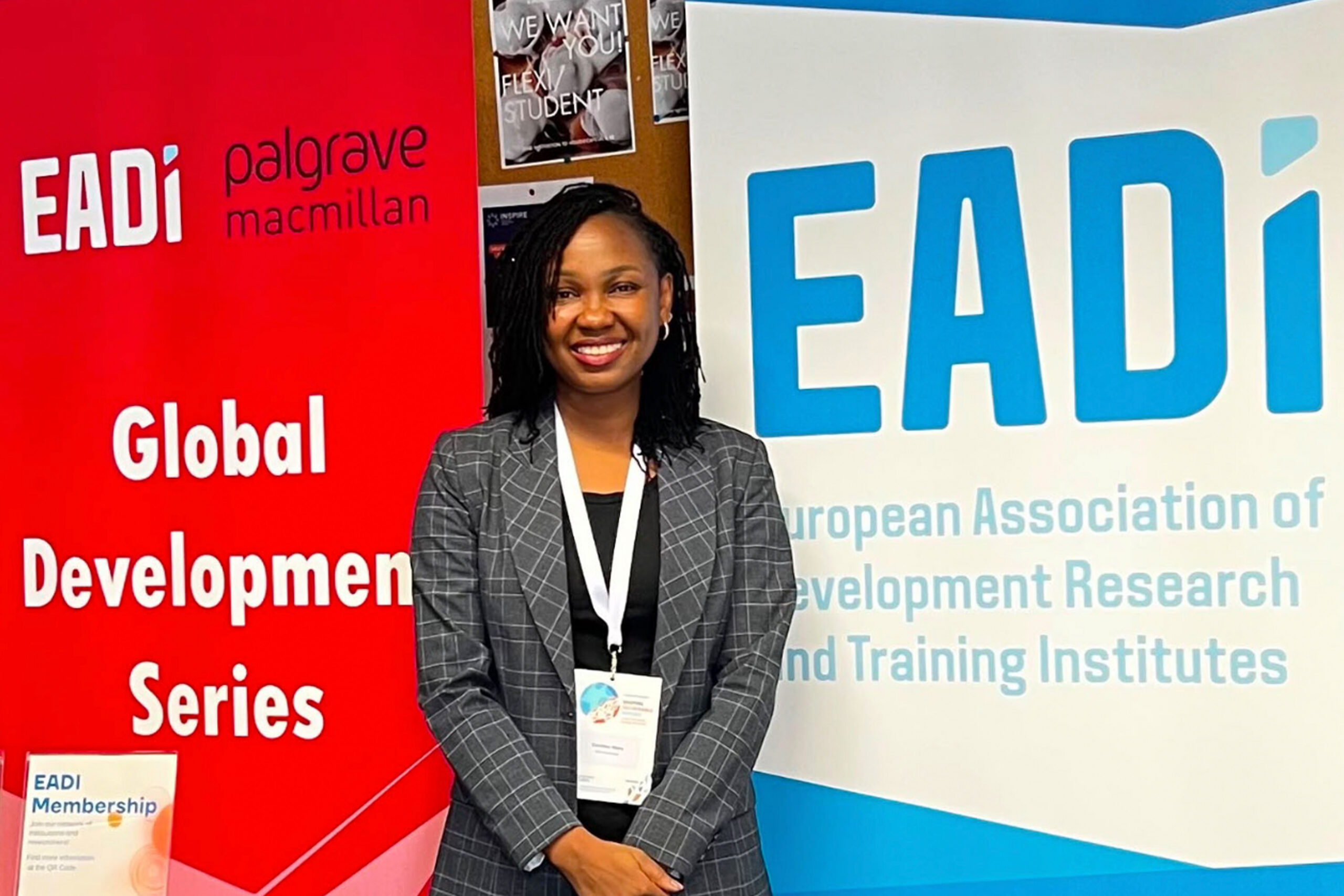
Jittip Mongkolnchaiarunya, a PhD student at George Washington University, has been awarded the 2026 Edward Said Award for her paper “Epistemic Exclusion in Climate Science: Why We Grow the Wrong Trees in the Wrong Places.”
Presented by the Global Development Studies (GDS) at the International Studies Association (ISA) Annual Convention, the Edward Said Award recognises outstanding scholarship in global development studies. The award includes a certificate presented at the ISA Annual Convention and a $500 prize, sponsored by Third World Quarterly in honour of Edward Said, one of the journal’s founding editorial board members.
Mongkolnchaiarunya’s award-winning paper draws on her doctoral research examining the politics of knowledge production in global climate governance, highlighting how epistemic exclusion shapes climate science and policy.

Jittip reflects on a key observation from her paper:
“Through my fieldwork I found that the climate science community’s preference for computational models poses obstacles for the inclusion of insights from ecological and biological fields, which are often more context-based. These obstacles are even more pronounced for scientists from the Global South, since many models and tools are built on Northern assumptions.
The systemic marginalisations of these insights is not only a matter of equity – about whose knowledge gets included, but also about how we understand the climate and can lead to counterproductive climate mitigation policy, such as growing the trees in the wrong places.”
Jittip Mongkolnchaiarunya
At ISA, we caught up with Jittip to discuss her research and what receiving the Edward Said Award means to her:
What inspired your research?
This project brings together four things I care deeply about: global governance, science and technology, climate change, and the Global South.
Scholarship on global governance has shown us that power isn’t just held by states – it can also lie with scientists, corporations, and even non-human technological objects. But much of that literature focuses on those who govern the globe – how they do so and how they come to occupy that position.
Perhaps partly because I come from the Global South myself, I was drawn to the other side of the story – those who are not in a position to govern in the first place. I became interested in scientific expertise from the Global South that is not always equally included in shaping global climate knowledge. I investigate what kinds of barriers are built into scientific practices, not through intentional exclusion, but through routines, standards, and infrastructures and what the consequences of these exclusions are – not only for the Global South but for the planet as a whole.
What does winning this Award mean to you?
Edward Said and the broader critical tradition of scholarship has significantly shaped the way I see the world. In particular, critical scholarship has made me attentive to unequal power dynamics that are not always immediately visible, but are deeply consequential, especially those embedded in the ways knowledge is produced and culture is sustained. This paper is very much in that spirit. I am truly honoured to receive the award.

Interested in becoming a member of ISA’s Global Development Studies (GDS) Section?
The ISA-GDS draws together scholars broadly concerned with development and global justice working across a number of fields, such as postcolonial studies, development studies, critical political economy, critical security studies, social and political theory, history, sociology, gender studies and public policy.
Visit the GDS page on the ISA website if you are interested in becoming a member, and email GDSnewsletter.ISA@gmail.com if you’d like to sign up to their newsletter.
About Jittip Mongkolnchaiarunya
Jittip Mongkolnchaiarunya is a Ph.D. Candidate in Political Science at George Washington University. Her dissertation investigates why counterproductive policies to mitigate climate change become adopted at the global level, with a focus on the science that guides global climate policy. It shows how policy missteps can be traced to the systematic marginalization of so-called complex and heterogeneous knowledge that do not “fit” within climate models—such as ecological findings from Southeast Asia or uncertainty in deep ocean research—at the expense of both effective global environmental policy and the region. I call this “epistemic exclusion.” Two empirical chapters, one about trees, the other about deep oceans, demonstrate these processes. A final theoretical chapter explores the implications of these exclusions for global environmental justice.
She has side projects on science and technology in global governance, the anti-escalation logic of strategic ambiguity, and network analysis in international relations. Her co-authored work, “Emotions and Expert Authority in Global Governance,” is published in the Oxford Handbook of Emotions in International Relations.
Prior to coming to GWU, Jittip received her MA in International Affairs from Columbia University and her BA from Thammasat University. She is the recipient of the Anandamahidol Foundation Scholarship under H.M. the King of Thailand (2015-2021).