What does it mean to care in contexts shaped by uncertainty? In this piece, three scholars (Ana María Cruz, Viviana García Pinzón and Jan Grill) based in Colombia and Germany reflect on the complexities and contradictions of care and care work, and the political implications and potential of caring in contexts of protests, violence, and marginalisation. The article centres on the experiences of women activists in the city of Cali, Colombia. Through practices such as ollas comunitarias – collective community kitchens – it examines how care becomes not only a means of survival, but also a form of resistance and political action.
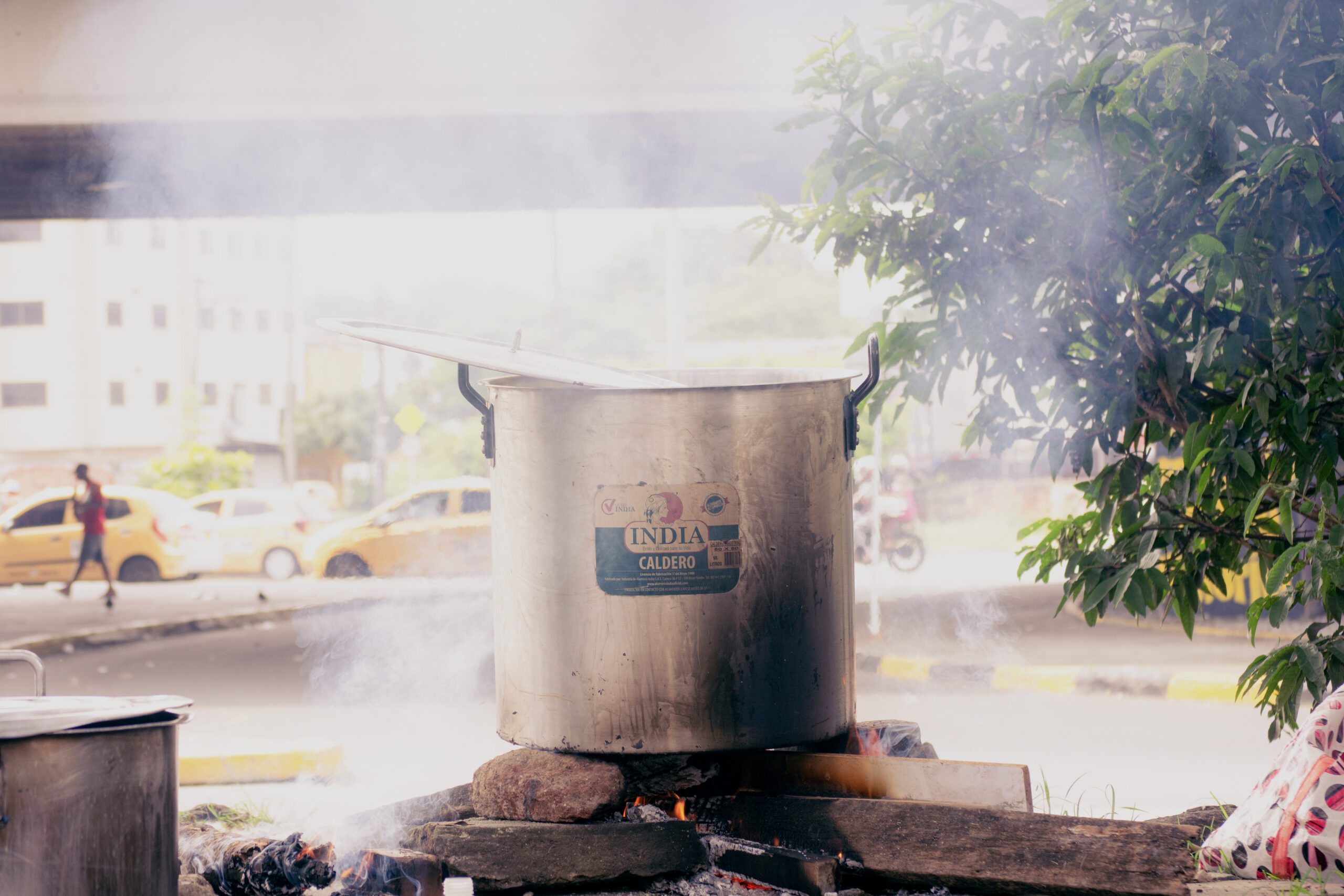
Image taken by Mariana Reina Villamil
Blackened with deeply ingrained soot stains that repeated washing could not remove, its body marked by indentations, fissures, and cracks, the piece of steel does not appear remarkable at first glance. Yet Martha caressed La Tapa Resistencia (the Pot Lid of Resistance), telling us how cherished it is to her.
She emphasised its necessity and usefulness, recalling the numerous occasions she has used it while cooking in the ollas comunitarias (community-based kitchens). This lid has served all the conventional purposes: helping food heat more quickly, retaining warmth and energy, and preserving moisture during cooking. But it also takes on more improvised roles: Martha uses it as a makeshift fan to stoke the wood embers, keeping alive the open-fire of the ollas comunitarias or placing it under the pot so ‘the rice does not burn’.
Beyond the kitchen, the lid carries another life. Battered by a wooden spoon, the pot lid’s metallic clang has echoed through the streets of Cali during protests – transforming an everyday object into a symbol of resistance.
“This is a struggle (Esto es lucha),” says Martha as she gently puts her palm on the lid while holding it firmly with the other hand. “But it got worn out from being used so much. We must recover it!”
The materiality of Martha’s potlid, with its marks and fractures, embodies a story of hard work, endurance and resistance as well as of exhaustion, vulnerability, and oppression. It prompts a broader question: What are the costs of caring, of “providing for others”, particularly in contexts traversed by violence and exclusion?
Focusing on the pot lid, its materiality, symbolic meanings and social relations, we explore the workings and dynamics of care among women who played a central role in the organisation and cooking of street community pots during a National Strike in 2021 in the city of Cali, in Colombia.
Protests, care and ollas comunitarias
Martha is part of a group of women locally known as the mamá ollas (‘mothers of the cooking pots’). This name emerged during the so-called “National Strike” (El Paro Nacional) in 2021 which was Colombia’s biggest wave of protests in its recent history.
Between April and June 2021 around 1.5 million people took to the streets to demand social and political change. Initially sparked by opposition to a tax reform under the government of then-President Iván Duque, the protests quickly became a broader forum for expressing a wide range of grievances and demands related to enduring conditions of inequality, violence, exclusion, and marginalisation. Although the tax reform was withdrawn in response to the protests, the social uprising continued.
Participation in the protests was multifaceted. Protestors included both middle and lower classes, women, students and youth, Indigenous communities, feminist movements, peasants, and a wide range of grassroots initiatives. Unlike more conventional protest movements, the 2021 National Strike was decentralised in both coordination and leadership. Most participants did not adhere to the call of a specific social movement or political party, instead digital platforms played a central role in facilitating the distribution of information, logistical coordination, and organisation.
The state’s response was marked by disproportionate violence against protesters, resulting in fatalities, injuries, eye injuries, sexual violence, and enforced disappearances. The government also portrayed protesters as criminals to undermine the legitimacy of the movement.

From a long-term perspective, the 2021 National Strike is part of a broader trajectory of intensified social mobilisation, linked to a cycle of mass protests unfolding since late 2019. While the COVID-19 pandemic in 2020 brought this wave of protests to a halt, its devastating effects on living conditions and public dissatisfaction with the government’s handling of the emergency compounded existing grievances.
Although the National Strike did not immediately lead to structural transformations, it contributed to the widening of political participation and imagination, particularly among subaltern sectors. In doing so, it helped to shape the conditions that ultimately led to the election of Gustavo Petro in 2022 as the first leftist government in the country’s history.
Cities played a central role in the geography of the National Strike. The city of Cali, in the South-West of Colombia, stood out due to the massive number of people partaking in demonstrations, the protests’ duration, and their impact. The mobilisation in Cali protests not only rejected the incumbent government but also contested an urban order rooted in multidimensional inequalities and racial segregation. These conditions are reflected in high levels of poverty, unemployment, and precarious living conditions that disproportionately affect Afro-descendant populations, indigenous communities, women, and youth.
Similar to other social movements worldwide, the occupation of space became a defining feature of the protests. In Cali, protesters blocked and occupied streets, turning them into sites of resistance, known as puntos de resistencia. Contentious action and everyday life met in these spaces. Alongside a diverse repertoire of protest practices, the lived space-time in the puntos de resistencia was shaped by ordinary, mundane everyday activities oriented towards the reproduction, maintenance, and repair of life – care.
By meeting protestors’ physical needs, an infrastructure of care underpinned the existence and continuity of the puntos de resistencia, and, more widely, of the protests. Sustaining life – through care labour – was tantamount to sustaining the uprising.
Equipped with huge pots, some basic kitchen utensils, sticks of wood to make a fire, and groceries collected either through donations or paid for out of their own meagre resources, a group of women emerged as key figures in the uprising, cooking tirelessly in the ollas comunitarias enacted in the puntos de resistencia.
These women, the mamá ollas, turned into networks of solidarity, support and mutual care, enabling the informal flow of goods and people that made possible the ollas comunitarias. By cooking in the ollas, the women were not only feeding hungry people, but also cultivating an affective infrastructure and ensemble of love, empathy, and solidarity that was crucial in sustaining and keeping people together during the protests.

Politics of care: inequality, struggles, and potential
In examining the politics of care, scholars have discussed its complexity and contradictions. While care is an essential activity that sustains lives, people, communities, and ecosystems, (and we have all been caregivers or on the receiving end of care at some point in our lives), care is also embedded in existing patriarchal, racist, colonial, capitalist structures of power and inequality.
In her book, Depletion The Human Costs of Caring, Shirin Rai notes, “the reproduction of life doesn’t just happen”, it demands “generative labor”, which in the framework of the capitalist socio-economic system is inherently unequal. Practices of care are defined and structured along the lines of gender, race, class, migration status, cross-generational relations, and location. Regardless of culture, geographical context, or religion, women tend to bear the greatest share of caregiving responsibilities. However, women’s experiences differ depending on class, race, and location meaning that resources, and costs inherent to care are unequally distributed.
Within the global political economy, demands for care labour have been increasingly commodified, feminised, and racialised. As a result, women of colour, immigrant women, and women in more precarious poorer socio-economic conditions are those who shoulder the lion’s share of necessary care work.
Care relations are largely shaped by how capitalism organises social reproduction — through exploitation, oppression, and structural violence. The disproportionate burden of caregiving places significant physical, emotional, and material strains on individuals and communities. Austerity policies driven by financialised capitalism have further weakened public care systems, shifting the costs of reduced welfare services and income onto working-class women and women of colour. While care needs keep growing, support and resources don’t, and care becomes depleting and harmful for those who provide it. Even then, the real costs of caring remain largely unacknowledged and undervalued.
At the same time, care holds transformative potential. It can challenge and disrupt entrenched orders of violence and exclusion. Amidst moments of crises and within conditions of chronic violence, care emerges as a vital political, social, and emotional resource allowing individuals and communities to adapt and endure. It sustains relations of compassion, solidarity and mutual support that, in turn, sets the basis for collective resistance against structures and forces that not only systematically devalue interdependence, but actively bring destruction and devastation.
Some forms of care exist outside the profit-driven logic of capitalism. Instead of focusing on profit extraction and accumulation, they help resist dehumanisation, foster alternative sustainable and cooperative forms of life, and plural ways of being in the world.
To understand care in contexts of conflict, violence and compounding crises requires a perspective capable of making sense of its multiple dimensions, and contradictions.
“The pot lid in the ollas comunitarias teaches us that, despite all its difficulties, caring creates and gives rise to something new.”
Ana María Cruz, Viviana García Pinzón and Jan Grill
Seeing care through cooking and a potlid

The pot lid, with its cracks, stains, and fissures, shows how hard it is to care for someone. Sometimes we think caring is easy; we think all we have to do is put the lid on the pot, without making any noise, without causing any reaction. But we know there is more to it than that.
Is it possible to make soup without covering the pot? How long would it take? Wouldn’t it require more time, more firewood, more effort? Caring, like cooking, needs warmth, persistence and presence while the broth boils, the meat softens, the potatoes fall apart and the flavours blend together. It is not immediate. Caring too requires patience, time and a tireless energy that is facilitated by the work, and contained by the presence of the caregivers.
When placed over heat, the lid sustains but it also wears out. This is what happens when we care for someone: the heat, pressure and heaviness of others also affects us. Caring implies making ourselves vulnerable to the other in order to recognise our own vulnerability. But removing those masks of strength, even if it hurts, even if it sometimes damages our skin, makes us stronger.
When cooking, it is possible to burn ourselves, and when that happens, we have to clean the wounds. When the wounds are treated we cry out, try to run away or tell them to stop because healing hurts. But how does it feel to take care of others while simultaneously trying to prevent our own wounds from becoming infected? There, in that silent gesture of being present for others while enduring our own pain, the wounds of care turn into scars.
Yet no matter how hard wearing the lid may seem, it is not invincible or eternal, and nor are we. Caring for others might be exhausting, leaving caregivers drained and with invisible marks. The lid can sink under pressure of receiving the steam from the soup for extensive periods of time. It stains, it can turn black and change colour, and it may not endure the heat as well as it once did, or be able to keep up with its high demand. The lid might get damaged and cracked when used too hastily as a makeshift fan, or lose its shape when put under the pot to absorb the heat of the fire. Yet these marks, these scars from the work, are signs of resistance.
Just like the hands of the mamá ollas, the pot lids are full of marks, burns, cuts. The skin is not the same after caring, and neither is the person. It becomes thicker with calluses, but also rougher and wiser. These are the marks left of having lived through the care for others. It can be filled with cracks, while still sustaining the others.
But what is a life without scars? What is a lid without stains?
While the lid does its job, the soup transforms. The aroma begins to fill the air and people gather around the pot, drawn by the promise that it is ready. The lid has allowed the food to cook, to season, and the ingredients to come together. Stir, mix the flavours, knowledge, affections and memories; combine one ingredient with another, love with fatigue and sacrifice with hope. That is what cooking is all about. And none of this would be possible without the lid that covers, protects, and endures.
Concluding remarks
The pot lid in the ollas comunitarias teaches us that, despite all its difficulties, caring creates and gives rise to something new. Caring gives life, sustains life, restores life. Like a warm bowl of soup that nourishes and comforts the body and soul, caring generates, transforms and gives rise to a world where warmth is shared and is possible.
From the pot comes a soup that is served indiscriminately to all who approach it: the soup is cooked for everyone. It is made to be shared, offered to all without exception. That is exactly what defines an olla comunitaria: everyone is welcome and everyone can eat, for food is a need that no human escapes – a basic manifestation of our shared vulnerability and interdependence.
Caring is in the small actions; in the cooking, the seasoning and stirring. We all sit around the pot. And the lid, somewhat invisible, often unnoticed and exhausted from its work, can finally rest. It sits quietly, appearing to smile as it watches everyone eating and chatting, savouring the soup that it helped to prepare.
In his book, The Soul of Care Arthur Kleinman talks about transforming facets of caring for his terminally-ill wife. A medical anthropologist, Kleinman describes caring as involving “work on the soul: that of the caregiver and also the receiver of care… as cultivation of the self and of one’s relationships. Cultivation represents work. And that work, so much of which is focused on another person feeds back to engage and readjust who we are. At best it elevates and refines us; at worst it depletes and burdens us.”
While Hanna-Kaisa Hoppania and Tiina Vaittinen argue that care is deeply political, and has the potential to challenge the way neoliberal societies organise their “households”. Perhaps if care activities, such as, preparing meals, and care were shared more equally, the caregiving mamá ollas would not end up being so exhausted, their burdens would be lighter, their scars fewer, and their pot lids less worn.
If we placed care at the centre of how we think about politics and society, it could open up new possibilities for action and transformation. By learning from the mamá ollas and from their pot lids, we might begin to imagine and build different, more caring worlds.
****
This article was commissioned by the Global Souths Hub after viewing a presentation at The Society of Latin American Studies Conference (SLAS) 2025. It was written in the framework of the Early-Career Research Tandem project Caring Life in and from the Urban Margins: Women, Ollas Comunitarias, and Everyday Resistance in Cali, Colombia, funded by the Decoloniality Now initiative at the University of Freiburg (Germany), and in cooperation with the collaborative research network ‘Postcolonial Hierarchies in Peace and Conflict’ [grant number 01UG2205A], funded by the German Federal Ministry of Research. Technology and Space (BMFTR).
The Authors:
Viviana García Pinzón
Viviana García Pinzón is a Senior Researcher at the Arnold-Bergstraesser-Institut ABI in Freiburg (Germany) and an Associate at the German Institute of Global and Area Studies GIGA. She holds a Ph.D. in Political Science from the Marburg University. Her research focuses on conflict, security, contested politics, and peace, with a focus on cities and borderlands. She co-edits the Virtual Encyclopedia ‘rewritingpeaceandconflict.net’. Her book ‘Trajectories of Governance. Tracing the Entanglements of Order and Violence in Peripheral Cities of Latin America’ (BUP, 2024) was awarded Best Book 2025, by the Defense, Public Security & Democracy Section, Latin American Studies Association (LASA).
Ana María Cruz Vidal
Ana María Cruz Vidal is a Doctoral Candidate in Sociology at the Universidad del Valle and an Associate Professor at Universidad Buenaventura in Cali, Colombia. She holds a Bachelor’s degree in Gastronomy from the University of La Sabana (Colombia) and a Magister in Anthropology from the University of Los Andes (Colombia). She is a researcher in cooking, care, gender, and participatory research methods.
Jan Grill
Jan Grill is a Professor of Sociology and Social Sciences at the Universidad del Valle in Cali, Colombia. He holds a PhD in Social Anthropology at the University of St Andrews (Scotland). He obtained his undergraduate degree in Social and Cultural Anthropology at the University of West Bohemia in Pilsen (Czech Republic) and his MA degree in Nationalism Studies at Central European University in Budapest in Hungary. His research interests informing his work are migration and mobilities, racialisation, marginality, social suffering, labour and work, ethics and politics of humanitarianism, the ethnography of state and borders, ethnicity, nationalism.